

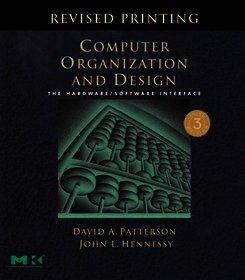
Computer Organization and Design, Revised Printing, Third Edition
The Hardware/Software Interface
Sorozatcím: The Morgan Kaufmann Series in Computer Architecture and Design;
-
10% KEDVEZMÉNY?
- A kedvezmény csak az 'Értesítés a kedvenc témákról' hírlevelünk címzettjeinek rendeléseire érvényes.
- Kiadói listaár EUR 46.95
-
18 338 Ft (17 465 Ft + 5% áfa)
Az ár azért becsült, mert a rendelés pillanatában nem lehet pontosan tudni, hogy a beérkezéskor milyen lesz a forint árfolyama az adott termék eredeti devizájához képest. Ha a forint romlana, kissé többet, ha javulna, kissé kevesebbet kell majd fizetnie.
- Kedvezmény(ek) 10% (cc. 1 834 Ft off)
- Kedvezményes ár 16 504 Ft (15 719 Ft + 5% áfa)
Iratkozzon fel most és részesüljön kedvezőbb árainkból!
Feliratkozom
18 338 Ft

Beszerezhetőség
A kiadónál véglegesen elfogyott, nem rendelhető. Érdemes újra keresni a címmel, hátha van újabb kiadás.
Why don't you give exact delivery time?
A beszerzés időigényét az eddigi tapasztalatokra alapozva adjuk meg. Azért becsült, mert a terméket külföldről hozzuk be, így a kiadó kiszolgálásának pillanatnyi gyorsaságától is függ. A megadottnál gyorsabb és lassabb szállítás is elképzelhető, de mindent megteszünk, hogy Ön a lehető leghamarabb jusson hozzá a termékhez.
A termék adatai:
- Kiadás sorszáma 3
- Kiadó Elsevier Science
- Megjelenés dátuma 2007. július 27.
- ISBN 9780123706065
- Kötéstípus Puhakötés
- Terjedelem752 oldal
- Méret 228x203 mm
- Súly 1343 g
- Nyelv angol 0
Kategóriák
Hosszú leírás:
What's New in the Third Edition, Revised Printing
The same great book gets better! This revised printing features all of the original content along with these additional features:
. Appendix A (Assemblers, Linkers, and the SPIM Simulator) has been moved from the CD-ROM into the printed book
. Corrections and bug fixes
Third Edition features
New pedagogical features
. Understanding Program Performance
- Analyzes key performance issues from the programmer's perspective
. Check Yourself Questions
- Helps students assess their understanding of key points of a section
. Computers In the Real World
- Illustrates the diversity of applications of computing technology beyond traditional desktop and servers
. For More Practice
- Provides students with additional problems they can tackle
. In More Depth
- Presents new information and challenging exercises for the advanced student
New reference features
. Highlighted glossary terms and definitions appear on the book page, as bold-faced entries in the index, and as a separate and searchable reference on the CD.
. A complete index of the material in the book and on the CD appears in the printed index and the CD includes a fully searchable version of the same index.
. Historical Perspectives and Further Readings have been updated and expanded to include the history of software R&D.
. CD-Library provides materials collected from the web which directly support the text.
In addition to thoroughly updating every aspect of the text to reflect the most current computing technology, the third edition
. Uses standard 32-bit MIPS 32 as the primary teaching ISA.
. Presents the assembler-to-HLL translations in both C and Java.
. Highlights the latest developments in architecture in Real Stuff sections:
- Intel IA-32
- Power PC 604
- Google's PC cluster
- Pentium P4
- SPEC CPU2000 benchmark suite for processors
- SPEC Web99 benchmark for web servers
- EEMBC benchmark for embedded systems
- AMD Opteron memory hierarchy
- AMD vs. 1A-64
New support for distinct course goals
Many of the adopters who have used our book throughout its two editions are refining their courses with a greater hardware or software focus. We have provided new material to support these course goals:
New material to support a Hardware Focus
. Using logic design conventions
. Designing with hardware description languages
. Advanced pipelining
. Designing with FPGAs
. HDL simulators and tutorials
. Xilinx CAD tools
New material to support a Software Focus
. How compilers work
. How to optimize compilers
. How to implement object oriented languages
. MIPS simulator and tutorial
. History sections on programming languages, compilers, operating systems and databases
On the CD
. NEW: Search function to search for content on both the CD-ROM and the printed text
. CD-Bars: Full length sections that are introduced in the book and presented on the CD
. CD-Appendixes: Appendices B-D
. CD-Library: Materials collected from the web which directly support the text
. CD-Exercises: For More Practice provides exercises and solutions for self-study
. In More Depth presents new information and challenging exercises for the advanced or curious student
. Glossary: Terms that are defined in the text are collected in this searchable reference
. Further Reading: References are organized by the chapter they support
. Software: HDL simulators, MIPS simulators, and FPGA design tools
. Tutorials: SPIM, Verilog, and VHDL
. Additional Support: Processor Models, Labs, Homeworks, Index covering the book and CD contents
Instructor Support
Instructor support provided on textbooks.elsevier.com:
. Solutions to all the exercises
. Figures from the book in a number of formats
. Lecture slides prepared by the authors and other instructors
. Lecture notes
Tartalomjegyzék:
1 Computer Abstractions and Technology
2 Instructions: Language of the Computer
3 Arithmetic for Computers
4 Assessing and Understanding Performance
5 The Processor: Datapath and Control
6 Enhancing Performance with Pipelining
7 Large and Fast: Exploiting Memory Hierarchy
8 Storage, Networks, and Other Peripherals
On the CD:
9 Multiprocessors
Appendix A: Assemblers, Linkers, and the Spim simulator
Appendix B: The Basics of Logic Design
Appendix C: Mapping Control to Hardware
Appendix D: A Survey of RISC Architectures for Desktop, Server, and Embedded Computers

