

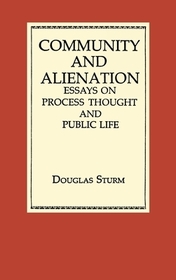
Community and Alienation
Essays on Process Thought and Public Life
-
20% KEDVEZMÉNY?
- A kedvezmény csak az 'Értesítés a kedvenc témákról' hírlevelünk címzettjeinek rendeléseire érvényes.
- Kiadói listaár GBP 32.00
-
14 448 Ft (13 760 Ft + 5% áfa)
Az ár azért becsült, mert a rendelés pillanatában nem lehet pontosan tudni, hogy a beérkezéskor milyen lesz a forint árfolyama az adott termék eredeti devizájához képest. Ha a forint romlana, kissé többet, ha javulna, kissé kevesebbet kell majd fizetnie.
- Kedvezmény(ek) 20% (cc. 2 890 Ft off)
- Kedvezményes ár 11 558 Ft (11 008 Ft + 5% áfa)
- A kedvezmény érvényes eddig: 2026. június 30.
Iratkozzon fel most és részesüljön kedvezőbb árainkból!
Feliratkozom
14 448 Ft

Beszerezhetőség
Megrendelésre a kiadó utánnyomja a könyvet. Rendelhető, de a szokásosnál kicsit lassabban érkezik meg.
Why don't you give exact delivery time?
A beszerzés időigényét az eddigi tapasztalatokra alapozva adjuk meg. Azért becsült, mert a terméket külföldről hozzuk be, így a kiadó kiszolgálásának pillanatnyi gyorsaságától is függ. A megadottnál gyorsabb és lassabb szállítás is elképzelhető, de mindent megteszünk, hogy Ön a lehető leghamarabb jusson hozzá a termékhez.
A termék adatai:
- Kiadó University of Notre Dame Press
- Megjelenés dátuma 1988. szeptember 30.
- Kötetek száma Print PDF
- ISBN 9780268007683
- Kötéstípus Keménykötés
- Terjedelem284 oldal
- Méret 229x152 mm
- Súly 666 g
- Nyelv angol
- Illusztrációk 3 tables - 3 Tables, unspecified Tables, unspecified 0
Kategóriák
Hosszú leírás:
Douglas Sturm, a major ethical thinker, here presents ten intriguing essays that lay the groundwork for a communitarian political theory. Drawing on the work of Alfred North Whitehead and Bernard E. Meland, Sturm brings the implications of process thought, especially its principle of internal relations, to bear on the interpretation and evaluation of our social and political life. He argues that American individualism, including its curious transmutations into the forms of corporativism, racism, and nationalism is a constraint that deprives us of a deeper, more complex understanding of ourselves and a richer sense of the goodness of our lives.
The essays contrast a communitarian political theory with alternative traditions of social thought, particularly those forms of individualism generated by Hobbes, Locke, and Bentham. Political realities of power, rights, and interests are not to be dismissed, according to Sturm, but they need to be cast within a concept of politics that sustains a community as a whole; thus public good and justice are defined as the central principles of public life. He isolates alternative theoretical perspectives and demonstrates how they deal with several current social and political dilemmas.
Sturm applies the principles of the communitarian political theory to a broad range of contemporary concerns: the character and legitimacy of the modern business corporation; the idea of democratic capitalism; legal realism as the prevailing jurisprudence of the practicing lawyer; the scope and focus of bioethics as a discipline. In doing so, he affirms both the inescapability of public life in our existence and the radical character of the evil that it often creates.
Több
