

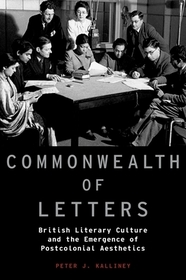
Commonwealth of Letters
British Literary Culture and the Emergence of Postcolonial Aesthetics
Sorozatcím: Modernist Literature and Culture;
-
10% KEDVEZMÉNY?
- A kedvezmény csak az 'Értesítés a kedvenc témákról' hírlevelünk címzettjeinek rendeléseire érvényes.
- Kiadói listaár GBP 97.00
-
43 795 Ft (41 710 Ft + 5% áfa)
Az ár azért becsült, mert a rendelés pillanatában nem lehet pontosan tudni, hogy a beérkezéskor milyen lesz a forint árfolyama az adott termék eredeti devizájához képest. Ha a forint romlana, kissé többet, ha javulna, kissé kevesebbet kell majd fizetnie.
- Kedvezmény(ek) 10% (kb. 4 379 Ft)
- Kedvezményes ár 39 416 Ft (37 539 Ft + 5% áfa)
Iratkozzon fel most és részesüljön kedvezőbb árainkból!
Feliratkozom
43 795 Ft

Beszerezhetőség
Megrendelésre a kiadó utánnyomja a könyvet. Rendelhető, de a szokásosnál kicsit lassabban érkezik meg.
Why don't you give exact delivery time?
A beszerzés időigényét az eddigi tapasztalatokra alapozva adjuk meg. Azért becsült, mert a terméket külföldről hozzuk be, így a kiadó kiszolgálásának pillanatnyi gyorsaságától is függ. A megadottnál gyorsabb és lassabb szállítás is elképzelhető, de mindent megteszünk, hogy Ön a lehető leghamarabb jusson hozzá a termékhez.
A termék adatai:
- Kiadó OUP USA
- Megjelenés dátuma 2013. szeptember 19.
- ISBN 9780199977970
- Kötéstípus Keménykötés
- Terjedelem336 oldal
- Méret 163x236x30 mm
- Súly 621 g
- Nyelv angol
- Illusztrációk 4 halftones 0
Kategóriák
Rövid leírás:
Peter Kalliney's original archival work demonstrates that metropolitan and colonial intellectuals used modernist theories of aesthetic autonomy to facilitate collaborative ventures.
TöbbHosszú leírás:
Commonwealth of Letters complicates the traditional understanding of the relationship between elite, aging modernists like T.S. Eliot and the generation of colonial poets and novelists from Africa and the Caribbean-- Kamau Brathwaite, Ngugi wa Thiong'o, Jean Rhys, and others-who rose to prominence after World War Two. Rather than a mostly one-sided relationship of exploitation, Kalliney emphasizes how both groups depended on-and thrived off-one another. The modernists, dispirited by the turn to a kind of bland, welfare-state realism in literature and the rise of commercial mass culture, sought rejuvenation and kindred spirits amongst a group of émigré writers from the Caribbean and Africa who had been educated in the literary curriculum exported to the colonies in the years before 1945. For their part, the postcolonial writers, ambitious for literary success and already skeptical of the trend toward corruption and philistinism among their compatriot anticolonial politicians, sought the access to cultural capital and the comforting embrace of literature provided by metropolitan modernists. As a result, modernist networks became defined by the exchange between metropolitan and colonial writers. In several chapters, Kalliney provides compelling analyses of colonial writers in postwar cultural institutions, such as the BBC, literary anthologies, and high profile English publishers such as Faber & Faber and Heinemann, developer of the African Writers Series. Throughout, Kalliney acknowledges the elements of cultural imperialism, and paternalism involved in these relationships; however, he broadens our perspective on postcolonial writers by emphasizing the strategic ways they manipulated these elite modernist networks to advance their own cultural agendas.Transatlantic Modernism and the Emergence of Postcolonial Literature is a study of midcentury literary institutions integral to modernism and postcolonial writing. Several organizations central to interwar modernism, such as the BBC, influential publishers, and university English departments, became important sites in the emergence of postcolonial literature after the war. How did some of modernism's leading figures of the 1930s, such as T.S. Eliot, Louis MacNeice, and Stephen Spender, come to admire late colonial and early postcolonial literature in the 1950s? Similarly, why did late colonial and early postcolonial writers--including Chinua Achebe, Kamau Brathwaite, Claude McKay, and Ngugi wa Thiong'o--actively seek alliances with metropolitan intellectuals? Peter Kalliney's original archival work on modernist cultural institutions demonstrates that this disparate group of intellectuals had strong professional incentives to treat one another more as fellow literary professionals, and less as political or cultural antagonists.
Surprisingly, metropolitan intellectuals and their late colonial counterparts leaned heavily on modernist theories of aesthetic autonomy to facilitate their collaborative ventures. For white, metropolitan writers, T.S. Eliot's notion of impersonality could help recruit new audiences and conspirators from colonized regions of the world. For black, colonial writers, aesthetic autonomy could be used to imagine a literary sphere uniquely resistant to the forms of racial prejudice endemic to the colonial system. This strategic collaboration did not last forever, but it left a lasting imprint on the ultimate disposition of modernism and the evolution of postcolonial literature.
It is the mapping of the literary networks, rivalries, allegiances and collaborations that marks Kalliney's book out as an important contribution in this turn of postcolonial studies to interaction with modernist periodicity and aesthetics ... Kalliney offers a truly expansive study of the importance of migration in the developmental history of modernism.
Tartalomjegyzék:
Acknowledgments and Permissions
1. Modernist Networks and Late Colonial Intellectual
2. Race and Modernist Anthologies: Nancy Cunard, Langston Hughes, Claude McKay, Ezra Pound
3. For Continuity: FR Leavis, Kamau Brathwaite, and Ngugi wa Thiong'o
4. Metropolitan Modernism and its West Indian Interlocutors
5. Developing Fictions: Amos Tutuola at Faber and Faber
6. Metropolitan Publisher as Postcolonial Clearinghouse: The African Writers Series
7. Jean Rhys: Left Bank Modernist as Postcolonial Intellectual
Conclusion
Bibliography

