

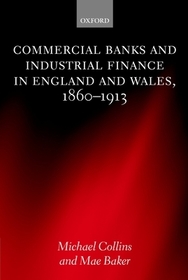
Commercial Banks and Industrial Finance in England and Wales, 1860-1913
-
10% KEDVEZMÉNY?
- A kedvezmény csak az 'Értesítés a kedvenc témákról' hírlevelünk címzettjeinek rendeléseire érvényes.
- Kiadói listaár GBP 147.50
-
66 596 Ft (63 425 Ft + 5% áfa)
Az ár azért becsült, mert a rendelés pillanatában nem lehet pontosan tudni, hogy a beérkezéskor milyen lesz a forint árfolyama az adott termék eredeti devizájához képest. Ha a forint romlana, kissé többet, ha javulna, kissé kevesebbet kell majd fizetnie.
- Kedvezmény(ek) 10% (cc. 6 660 Ft off)
- Kedvezményes ár 59 937 Ft (57 083 Ft + 5% áfa)
Iratkozzon fel most és részesüljön kedvezőbb árainkból!
Feliratkozom
66 596 Ft

Beszerezhetőség
Megrendelésre a kiadó utánnyomja a könyvet. Rendelhető, de a szokásosnál kicsit lassabban érkezik meg.
Why don't you give exact delivery time?
A beszerzés időigényét az eddigi tapasztalatokra alapozva adjuk meg. Azért becsült, mert a terméket külföldről hozzuk be, így a kiadó kiszolgálásának pillanatnyi gyorsaságától is függ. A megadottnál gyorsabb és lassabb szállítás is elképzelhető, de mindent megteszünk, hogy Ön a lehető leghamarabb jusson hozzá a termékhez.
A termék adatai:
- Kiadó OUP Oxford
- Megjelenés dátuma 2003. december 11.
- ISBN 9780199249862
- Kötéstípus Keménykötés
- Terjedelem310 oldal
- Méret 242x162x21 mm
- Súly 585 g
- Nyelv angol
- Illusztrációk numerous tables and figures 0
Kategóriák
Rövid leírás:
This new, authoritative interpretation of bank-industry relations in the late-nineteenth and early-twentieth centuries considers whether deficiencies in the financial provision from banks to British industry handicapped Britain's competitive advantage in world markets. Using a rich source of contemporary records, and mircro-economic studies, an economic rationale for historical bank behaviour is expounded.
TöbbHosszú leírás:
In the decades before 1914, the City of London was the premier international financial centre. However, this position was not long maintained, other industrial nations quickly and effectively challenged the influence of Britain, and following the disruption of the world markets caused by World War I and the Great Depression of the 1930s, international hegemony slipped away for ever.
The relationship of bankers and industrialists has often been cited as a key factor in this decline. Critics of the banks claim that, even before World War I, there were serious deficiencies in the financial provision provided by banks to the domestic industrial sector, and that these deficiencies handicapped Britain's competitive advantage in world markets, leading to the decline of their influence and power.
This book examines these claims, and bringing to bear important new data that presents the debate in a novel and revealing framework, expounds an economic rationale for historical bank behaviour. Using a rich source of contemporary records, it presents a series of micro-economic studies into commercial bank assets and liabilities, financial crises, bank mergers, the professionalization of banking, the organization and conduct of the industrial loan business, and the nature of bank support given to industrial clients.
The result is a new, authoritative interpretation of bank-industry relations in the half-century before World War I.
This is fundamental reading in British (and European) banking history, and also a very informative and stimulating source for economic and business historian alike.
Tartalomjegyzék:
The Relationship between Finance and Industry in Britain
Comparative European Banking Developments
Relationship Banking and Transaction Banking: Conceptual Issues
Trends in Commercial Bank Liabilities
The Impact of Financial Crises on Commercial Bank Behaviour
Bank Mergers and the Impact on Asset Structures, 1860-1913
Contemporary Opinion on Bank Lending
Professionalization, Organization, and Control
The Nature of Commercial Banks' Industrial Loans
Loan Refusals
Business Clients' Financial Distress
Conclusion
Appendices

