

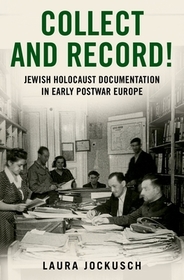
Collect and Record!
Jewish Holocaust Documentation in Early Postwar Europe
Sorozatcím: Oxford Series on History and Archives;
-
10% KEDVEZMÉNY?
- A kedvezmény csak az 'Értesítés a kedvenc témákról' hírlevelünk címzettjeinek rendeléseire érvényes.
- Kiadói listaár GBP 110.00
-
49 665 Ft (47 300 Ft + 5% áfa)
Az ár azért becsült, mert a rendelés pillanatában nem lehet pontosan tudni, hogy a beérkezéskor milyen lesz a forint árfolyama az adott termék eredeti devizájához képest. Ha a forint romlana, kissé többet, ha javulna, kissé kevesebbet kell majd fizetnie.
- Kedvezmény(ek) 10% (cc. 4 967 Ft off)
- Kedvezményes ár 44 699 Ft (42 570 Ft + 5% áfa)
Iratkozzon fel most és részesüljön kedvezőbb árainkból!
Feliratkozom
49 665 Ft

Beszerezhetőség
Megrendelésre a kiadó utánnyomja a könyvet. Rendelhető, de a szokásosnál kicsit lassabban érkezik meg.
Why don't you give exact delivery time?
A beszerzés időigényét az eddigi tapasztalatokra alapozva adjuk meg. Azért becsült, mert a terméket külföldről hozzuk be, így a kiadó kiszolgálásának pillanatnyi gyorsaságától is függ. A megadottnál gyorsabb és lassabb szállítás is elképzelhető, de mindent megteszünk, hogy Ön a lehető leghamarabb jusson hozzá a termékhez.
A termék adatai:
- Kiadó OUP USA
- Megjelenés dátuma 2012. október 11.
- ISBN 9780199764556
- Kötéstípus Keménykötés
- Terjedelem336 oldal
- Méret 165x236x30 mm
- Súly 618 g
- Nyelv angol
- Illusztrációk 15 b/w halftones 0
Kategóriák
Rövid leírás:
This volume tells the largely unknown story of Holocaust survivors who founded Jewish historical commissions and documentation centers in Europe immediately after World War II. Their initiatives collected thousands of Nazi documents along with testimonies, questionnaires, and large numbers of memoirs, diaries, songs, poems, and artifacts of Jewish victims. They pioneered the development of a Holocaust historiography that used both victim and perpetrator sources to describe the social, economic, and cultural aspects of the everyday life and death of European Jews under the Nazi regime, while placing the experiences of Jews at the center of the story.
TöbbHosszú leírás:
This volume tells the largely unknown story of Holocaust survivors who founded Jewish historical commissions and documentation centers in Europe immediately after World War II. Amidst political turmoil and extreme privation, physically exhausted and traumatized women and men who had survived ghettos, camps, hiding, or life under false identities sought to chronicle the catastrophe. They collected thousands of Nazi documents along with more than 18,000 testimonies, some 8,000 questionnaires, and large numbers of memoirs, diaries, songs, poems, and artifacts of Jewish victims.
The activists found documenting the Holocaust to be a moral imperative after the war, the obligation of the dead to the living, and a means to understand and process their recent trauma and loss. They deemed historical documentation vital in the pursuit of postwar justice and essential in counteracting the Nazis' wartime efforts to erase the evidence of their crimes. These Jewish documentation initiatives pioneered the development of a Holocaust historiography that used both victim and perpetrator sources to describe the social, economic, and cultural aspects of the everyday life and death of European Jews under the Nazi regime, while placing the experiences of Jews at the center of the story. These groundbreaking efforts of survivors to study the Nazi regime's genocide of European Jews was ignored by subsequent generations of Holocaust scholars.
With a comparative analysis, Jockusch focuses on France, Poland, Germany, Austria, and Italy to illuminate the transnational nature of Jewish efforts to write the history of the Holocaust in its immediate aftermath. The book explores the motivations and rationales that guided survivors in chronicling the destruction they had witnessed, their research techniques, archival collections, and historical publications. As the first comprehensive study on the subject, this book serves as an important complement to the literature on survivor testimony, Holocaust memory, and the rebuilding of Jewish life in postwar Europe.
Collect and Record! surveys the groundbreaking institutions in France and Poland that organized the earliest Holocaust research. While we have known about institutions like the Centre de documentation juive contemporaine in France and the Central Jewish Historical Commission in Poland, the responses of the many who struggled to tell their story have not been brought together before and Jockusch deserves enormous credit for recording their narratives in such rich and compelling detail. Perhaps most pioneeringly, she shows that Jews took up forms of historical writing even in the difficult circumstances of the continents displaced persons camps, a phenomenon never studied before.
Tartalomjegyzék:
Note on Translations and Transliterations
List of Abbreviations
Introduction: Early Chroniclers of the Holocaust: Jewish Historical Commissions and Documentation Centers in the Aftermath of the Second World War
1. Khurbn-Forshung: History Writing as a Jewish Response to Catastrophe
2. Writing French Judaism's "Book of Martyrdom": Holocaust Documentation in Liberated France
3. Writing Polish Jewry's "Greatest National Catastrophe": Holocaust Documentation in Communist Poland
4. Writing History on Packed Suitcases: Holocaust Documentation in the Jewish Displaced Persons Camps of Germany, Austria, and Italy
Conclusion: History Writing as Reconstruction: The Beginnings of Holocaust Research from the Perspective of Its Victims
Appendix: Major Participants in the Jewish Historical Commissions and Documentation Centers
Notes
Bibliography
Index

