

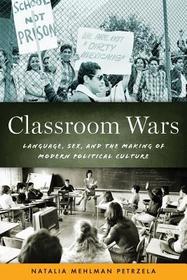
Classroom Wars
Language, Sex, and the Making of Modern Political Culture
-
10% KEDVEZMÉNY?
- A kedvezmény csak az 'Értesítés a kedvenc témákról' hírlevelünk címzettjeinek rendeléseire érvényes.
- Kiadói listaár GBP 32.99
-
14 894 Ft (14 185 Ft + 5% áfa)
Az ár azért becsült, mert a rendelés pillanatában nem lehet pontosan tudni, hogy a beérkezéskor milyen lesz a forint árfolyama az adott termék eredeti devizájához képest. Ha a forint romlana, kissé többet, ha javulna, kissé kevesebbet kell majd fizetnie.
- Kedvezmény(ek) 10% (cc. 1 489 Ft off)
- Kedvezményes ár 13 405 Ft (12 767 Ft + 5% áfa)
Iratkozzon fel most és részesüljön kedvezőbb árainkból!
Feliratkozom
14 894 Ft

Beszerezhetőség
Megrendelésre a kiadó utánnyomja a könyvet. Rendelhető, de a szokásosnál kicsit lassabban érkezik meg.
Why don't you give exact delivery time?
A beszerzés időigényét az eddigi tapasztalatokra alapozva adjuk meg. Azért becsült, mert a terméket külföldről hozzuk be, így a kiadó kiszolgálásának pillanatnyi gyorsaságától is függ. A megadottnál gyorsabb és lassabb szállítás is elképzelhető, de mindent megteszünk, hogy Ön a lehető leghamarabb jusson hozzá a termékhez.
A termék adatai:
- Kiadó OUP USA
- Megjelenés dátuma 2017. április 20.
- ISBN 9780190675097
- Kötéstípus Puhakötés
- Terjedelem336 oldal
- Méret 234x156x19 mm
- Súly 517 g
- Nyelv angol
- Illusztrációk 14 illus. 0
Kategóriák
Rövid leírás:
Considering two of the 1960s and 70s' most innovative educational programs--Spanish-bilingual and sex education-- Natalia Mehlman Petrzela charts how during a time of extraordinary social change, Americans fused values about family, personal, and civic morality in their children's public school education.
TöbbHosszú leírás:
The schoolhouse has long been a crucible in the construction and contestation of the political concept of "family values." Through Spanish-bilingual and sex education, moderates and conservatives in California came to define the family as a politicized and racialized site in the late 1960s and 1970s. Sex education became a vital arena in the culture wars as cultural conservatives imagined the family as imperiled by morally lax progressives and liberals who advocated for these programs attempted to manage the onslaught of sexual explicitness in broader culture. Many moderates, however, doubted the propriety of addressing such sensitive issues outside the home. Bilingual education, meanwhile, was condemned as a symbol of wasteful federal spending on ethically questionable curricula and an intrusion on local prerogative. Spanish-language bilingual-bicultural programs may seem less relevant to the politics of family, but many Latino parents and students attempted to assert their authority, against great resistance, in impassioned demands to incorporate their cultural and linguistic heritage into the classroom. Both types of educational programs, in their successful implementation and in the reaction they inspired, highlight the rightward turn and enduring progressivism in postwar American political culture.
In Classroom Wars, Natalia Mehlman Petrzela charts how a state and a citizenry deeply committed to public education as an engine of civic and moral education navigated the massive changes brought about by the 1960s, including the sexual revolution, school desegregation, and a dramatic increase in Latino immigration. She traces the mounting tensions over educational progressivism, cultural and moral decay, and fiscal improvidence, using sources ranging from policy documents to student newspapers, from course evaluations to oral histories. Petrzela reveals how a growing number of Americans fused values about family, personal, and civic morality, which galvanized a powerful politics that engaged many Californians and, ultimately, many Americans. In doing so, they blurred the distinction between public and private and inspired some of the fiercest classroom wars in American history. Taking readers from the cultures of Orange County mega-churches to Berkeley coffeehouses, Natalia Mehlman Petrzela's history of these classroom controversies sheds light on the bitterness of the battles over diversity we continue to wage today and their influence on schools and society nationwide.
Admirably and provocatively, Petrzela draws multiple connections between subjects often treated separately: between bilingual education and sex education; between bilingual education, sex education, and the property tax revolt that began in California and swept through the nation; between cultural politics in the classroom and fiscal politics over school funding; and between educational history/historiography and political history/historiography.
Tartalomjegyzék:
Acknowledgments
Introduction
Part One: Language
The Beginnings of Modern Bilingual Education
The Polarization of Bilingual Education
"Birds of Many Colors": Language, Culture, and Community in 1970s San Jose
"Some Kind of Precedent": The Ambiguous Legacy of Bilingual Education
Part Two: Sex
"The Pot was Already Boiling": Parents, Teachers, Taxes, and Sex Education in San Mateo
Family Life and Sex Education and the Unmaking of Anaheim's "Golden Age"
"Which Way America?" California's Moral Guidelines Committee and the Forging of a Patriotic Morality
"This Thing is Spreading All Over California": Sex Education in the Seventies
Conclusion
Appendix
Notes
Bibliography
Index

