

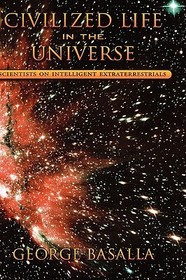
Civilized Life in the Universe
Scientists on Intelligent Extraterrestrials
-
10% KEDVEZMÉNY?
- A kedvezmény csak az 'Értesítés a kedvenc témákról' hírlevelünk címzettjeinek rendeléseire érvényes.
- Kiadói listaár GBP 43.99
-
21 016 Ft (20 015 Ft + 5% áfa)
Az ár azért becsült, mert a rendelés pillanatában nem lehet pontosan tudni, hogy a beérkezéskor milyen lesz a forint árfolyama az adott termék eredeti devizájához képest. Ha a forint romlana, kissé többet, ha javulna, kissé kevesebbet kell majd fizetnie.
- Kedvezmény(ek) 10% (cc. 2 102 Ft off)
- Kedvezményes ár 18 914 Ft (18 014 Ft + 5% áfa)
Iratkozzon fel most és részesüljön kedvezőbb árainkból!
Feliratkozom
21 016 Ft

Beszerezhetőség
Megrendelésre a kiadó utánnyomja a könyvet. Rendelhető, de a szokásosnál kicsit lassabban érkezik meg.
Why don't you give exact delivery time?
A beszerzés időigényét az eddigi tapasztalatokra alapozva adjuk meg. Azért becsült, mert a terméket külföldről hozzuk be, így a kiadó kiszolgálásának pillanatnyi gyorsaságától is függ. A megadottnál gyorsabb és lassabb szállítás is elképzelhető, de mindent megteszünk, hogy Ön a lehető leghamarabb jusson hozzá a termékhez.
A termék adatai:
- Kiadó OUP USA
- Megjelenés dátuma 2006. február 23.
- ISBN 9780195171815
- Kötéstípus Keménykötés
- Terjedelem248 oldal
- Méret 238x178x21 mm
- Súly 562 g
- Nyelv angol
- Illusztrációk 3 halftones, 28 line drawings 0
Kategóriák
Hosszú leírás:
This book is a selective and fascinating history of scientific speculation about intelligent extraterrestrial life. From Plutarch to Stephen Hawking, some of the most prominent western scientists have had quite detailed perceptions and misperceptions about alien civilizations: Johannes Kepler, fresh from transforming astronomy with his work on the shape of planetary orbits, was quite sure alien engineers on the moon were excavating circular pits to provide shelter; Christiaan Huygens, the most prominent physical scientist between Galileo and Newton, dismissed Kepler's speculations, but used the laws of probability to prove that "planetarians" on other worlds are much like humans, and had developed a sense of the visual arts; Carl Sagan sees clearly that Huygens is a biological chauvinist, but doesn't see as clearly that he, Sagan, may be a cultural/technological chauvinist when he assumes aliens have highly developed technology like ours, but better.
Basalla traces the influence of one speculation on the next, showing an unbroken but twisting chain of ideas passed from one scientist to the next, and from science to popular culture. He even traces the influence of popular culture on science--Sagan always admitted how much E. R. Burroughs' Martian novels influenced his speculations about Mars. Throughout, Basalla weaves his theme that scientific belief in and search for extraterrestrial civilizations is a complex impulse, part secularized-religious, and part anthropomorphic. He questions the common modern scientific reasoning that life converges on intelligence, and intelligence converges on one science valid everywhere. He ends the book by agreeing with Stephen Hawking (usually a safe bet) that intelligence is overrated for survival in the universe, and that we are most likely alone.
The text is well illustrated with a historical series of ancient to more modern graphics. The book, Civilized Life in the Universe, could easily make a text basis for a fascinating course on the subject.
Tartalomjegyzék:
Trio of Ideas
Life on the Moon
From the Moon to the Planets
The Ascension of Mars
Percival Lowell: Champion of Canals
Mars Unveiled
Carl Sagan: Mars and Beyond
Life in an Expanding Universe
The Trajectory: CETI to SETI to HRMS
Mirror Worlds
Afterword
Sources of Quoted Material
Bibliography

