

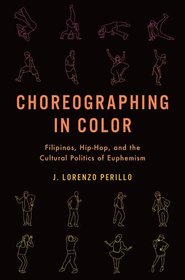
Choreographing in Color
Filipinos, Hip-Hop, and the Cultural Politics of Euphemism
-
10% KEDVEZMÉNY?
- A kedvezmény csak az 'Értesítés a kedvenc témákról' hírlevelünk címzettjeinek rendeléseire érvényes.
- Kiadói listaár GBP 115.00
-
51 922 Ft (49 450 Ft + 5% áfa)
Az ár azért becsült, mert a rendelés pillanatában nem lehet pontosan tudni, hogy a beérkezéskor milyen lesz a forint árfolyama az adott termék eredeti devizájához képest. Ha a forint romlana, kissé többet, ha javulna, kissé kevesebbet kell majd fizetnie.
- Kedvezmény(ek) 10% (cc. 5 192 Ft off)
- Kedvezményes ár 46 730 Ft (44 505 Ft + 5% áfa)
Iratkozzon fel most és részesüljön kedvezőbb árainkból!
Feliratkozom
51 922 Ft

Beszerezhetőség
Megrendelésre a kiadó utánnyomja a könyvet. Rendelhető, de a szokásosnál kicsit lassabban érkezik meg.
Why don't you give exact delivery time?
A beszerzés időigényét az eddigi tapasztalatokra alapozva adjuk meg. Azért becsült, mert a terméket külföldről hozzuk be, így a kiadó kiszolgálásának pillanatnyi gyorsaságától is függ. A megadottnál gyorsabb és lassabb szállítás is elképzelhető, de mindent megteszünk, hogy Ön a lehető leghamarabb jusson hozzá a termékhez.
A termék adatai:
- Kiadó OUP USA
- Megjelenés dátuma 2020. szeptember 30.
- ISBN 9780190054274
- Kötéstípus Keménykötés
- Terjedelem272 oldal
- Méret 160x237x20 mm
- Súly 581 g
- Nyelv angol
- Illusztrációk 25 figures, 2 tables 42
Kategóriák
Rövid leírás:
In Choreographing in Color, J. Lorenzo Perillo draws on nearly two decades of ethnography, choreographic analysis, and community engagement to ask: what does it mean for Filipinos to navigate violent forces of empire and neoliberalism with street dance and Hip-Hop?
TöbbHosszú leírás:
In Choreographing in Color, J. Lorenzo Perillo investigates the development of Filipino popular dance and performance since the late 20th century. Drawing from nearly two decades of ethnography, choreographic analysis, and community engagement with artists, choreographers, and organizers, Perillo shifts attention away from the predominant Philippine neoliberal and U.S. imperialist emphasis on Filipinos as superb mimics, heroic migrants, model minorities, subservient wives, and natural dancers and instead asks: what does it mean for Filipinos to navigate the violent forces of empire and neoliberalism with street dance and Hip-Hop?
Employing critical race, feminist, and performance studies, Perillo analyzes the conditions of possibility that gave rise to Filipino dance phenomena across viral, migrant, theatrical, competitive, and diplomatic performance in the Philippines and diaspora. Advocating for serious engagements with the dancing body, Perillo rethinks a staple of Hip-Hop's regulation, the "euphemism," as a mode of social critique for understanding how folks have engaged with both racial histories of colonialism and gendered labor migration. Figures of euphemism - the zombie, hero, robot, and judge - constitute a way of seeing Filipino Hip-Hop as contiguous with a multi-racial repertoire of imperial crossing, thus uncovering the ways Black dance intersects Filipino racialization and reframing the ongoing, contested underdog relationship between Filipinos and U.S. global power. Choreographing in Color therefore reveals how the Filipino dancing body has come to be, paradoxically, both globally recognized and indiscernible.
... [B]y also focusing on the historical and embodied relations between Filipinoness and Blackness, Perillo's work follows in the footsteps of hip-hop scholars such as Halifu Osumare and H. Samy Alim. Perillo shares with Osumare and Alim the critical analysis of hip-hop artists that transcend borders and cultures and the complex affinities created by global hip-hop practices.
Tartalomjegyzék:
Introduction: Choreographing in Color
Chapter 1: Zombies and Prisoner Rehabilitation
Chapter 2: Heroes and Filipino Migrations
Chapter 3: Robots and Affirmative Choreographies
Chapter 4: Judges and International Competitions
Conclusion: Hip-Hop Ambassadors and Conventions
Notes
Bibliography
Index

