

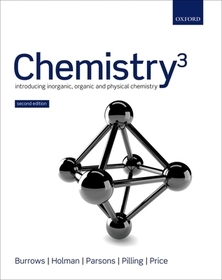
Chemistry3
Introducing inorganic, organic and physical chemistry
-
10% KEDVEZMÉNY?
- A kedvezmény csak az 'Értesítés a kedvenc témákról' hírlevelünk címzettjeinek rendeléseire érvényes.
- Kiadói listaár GBP 50.99
-
23 021 Ft (21 925 Ft + 5% áfa)
Az ár azért becsült, mert a rendelés pillanatában nem lehet pontosan tudni, hogy a beérkezéskor milyen lesz a forint árfolyama az adott termék eredeti devizájához képest. Ha a forint romlana, kissé többet, ha javulna, kissé kevesebbet kell majd fizetnie.
- Kedvezmény(ek) 10% (cc. 2 302 Ft off)
- Kedvezményes ár 20 719 Ft (19 733 Ft + 5% áfa)
Iratkozzon fel most és részesüljön kedvezőbb árainkból!
Feliratkozom
23 021 Ft

Beszerezhetőség
A kiadónál véglegesen elfogyott, nem rendelhető. Érdemes újra keresni a címmel, hátha van újabb kiadás.
Why don't you give exact delivery time?
A beszerzés időigényét az eddigi tapasztalatokra alapozva adjuk meg. Azért becsült, mert a terméket külföldről hozzuk be, így a kiadó kiszolgálásának pillanatnyi gyorsaságától is függ. A megadottnál gyorsabb és lassabb szállítás is elképzelhető, de mindent megteszünk, hogy Ön a lehető leghamarabb jusson hozzá a termékhez.
A termék adatai:
- Kiadás sorszáma 2
- Kiadó OUP Oxford
- Megjelenés dátuma 2013. március 21.
- ISBN 9780199691852
- Kötéstípus Puhakötés
- Terjedelem1440 oldal
- Méret 275x222x50 mm
- Súly 2858 g
- Nyelv angol 0
Kategóriák
Rövid leírás:
Chemistry3 establishes the fundamental principles of all three strands of chemistry; organic, inorganic and physical. By building on what students have learned at school, using carefully-worded explanations, annotated diagrams and worked examples, it presents an approachable introduction to chemistry and its relevance to everyday life.
TöbbHosszú leírás:
Chemistry is widely considered to be the central science: it encompasses concepts on which all other branches of science are developed. Yet, for many students entering university, gaining a firm grounding in chemistry is a real challenge. Chemistry3 responds to this challenge, providing students with a full understanding of the fundamental principles of chemistry on which to build later studies.
Uniquely amongst the introductory chemistry texts currently available, Chemistry3 is written by a team of chemists to give equal coverage of organic, inorganic and physical chemistry - coverage that is uniformly authoritative. The approach to organic chemistry is mechanistic, rather than the old-fashioned 'functional group' approach, to help students achieve a fuller understanding of the underlying principles.
The expertise of the author team is completed by two specialists in chemistry education, who bring to the book a wealth of experience of teaching chemistry in a way that students enjoy and understand. The result is a text that builds on what students know already from school and tackles their misunderstandings and misconceptions, thereby providing a seamless transition from school to undergraduate study.
The authors achieve unrivalled accessibility through the provision of carefully-worded explanations and reminders of students' existing knowledge; the introduction of concepts in a logical and progressive manner; and the use of annotated diagrams and step-by-step worked examples. Students are encouraged to engage with the text and appreciate the central role that chemistry plays in our lives through the unique use of real-world context and photographs.
Chemistry3 tackles head-on two issues pervading chemistry education: the students' mathematical skills, and their ability to see the subject as a single, unified discipline. Instead of avoiding the maths, Chemistry3 provides structured support, in the form of careful explanations, reminders of key mathematical concepts, step-by-step calculations in worked examples, and a Maths Toolkit, to help students get to grips with the essential mathematical element of
chemistry. Frequent cross-references highlight the connections between each strand of chemistry and explain the relationship between the topics, so students can develop an understanding of the subject as a whole.
Online Resource Centre:
The following resources are available to provide a full teaching and learning package:
For students:
· Interactive and animation-based activities which encourage students to actively learn.
· Fully-worked answers to the questions at the end of worked examples, boxes, and at the end of each chapter.
· 3D rotatable molecular structures and interactive 3D animations of key reactions.
· Video 'Screencasts' in which authors talk through selected examples and key reaction mechanisms step-by-step.
· Links to relevant video content, to demonstrate concepts discussed in the book.
· Learning outcomes, summaries, and key equations for each chapter of the book.
· A 'Transition to Chemistry' site for students about to embark on an undergraduate chemistry degree, to give a flavour of what undergraduate chemistry is like.
For registered adopters of the book:
· A 'test bank' of multiple choice questions.
· Illustrations from the book available to download.
Review from previous edition On reading the background information provided for this text, I could immediately see the potential benefit of such a book for first year undergraduate students studying chemistry or related courses. I believe that with the increased coverage, combined with the attractive layout and writing style, this text will be very well accepted by the staff and students of Chemistry Departments, particularly in the UK.
Tartalomjegyzék:
Fundamentals
The language of organic chemistry
Atomic structure and properties
Diatomic molecules
Polyatomic molecules
Solids
Acids and bases
Gases
Reaction kinetics
Molecular spectroscopy
Analytical chemistry
Molecular characterization
Energy and thermochemistry
Entropy and Gibbs energy
Chemical equilibrium
Electrochemistry
Phase equilibrium and solutions
Isomerism and stereochemistry
Organic reaction mechanisms
Halogenoalkanes: substitution and elimination reactions
Alkenes and alkynes: electrophilic addition and pericyclic reactions
Benzene and other aromatic compounds: electrophilic substitution reactions
Aldehydes and ketones: nucleophilic addition and alpha-substitution reactions
Carboxylic acids and derivatives: nucleophilic acyl substitution and alpha-substitution reactions
Hydrogen
s-block chemistry
p-block chemistry
d-block chemistry
Maths Toolkit
Appendices

