

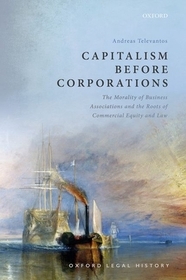
Capitalism Before Corporations
The morality of business associations and the roots of commercial equity and law
Sorozatcím: Oxford Legal History;
-
10% KEDVEZMÉNY?
- A kedvezmény csak az 'Értesítés a kedvenc témákról' hírlevelünk címzettjeinek rendeléseire érvényes.
- Kiadói listaár GBP 110.00
-
49 665 Ft (47 300 Ft + 5% áfa)
Az ár azért becsült, mert a rendelés pillanatában nem lehet pontosan tudni, hogy a beérkezéskor milyen lesz a forint árfolyama az adott termék eredeti devizájához képest. Ha a forint romlana, kissé többet, ha javulna, kissé kevesebbet kell majd fizetnie.
- Kedvezmény(ek) 10% (cc. 4 967 Ft off)
- Kedvezményes ár 44 699 Ft (42 570 Ft + 5% áfa)
Iratkozzon fel most és részesüljön kedvezőbb árainkból!
Feliratkozom
49 665 Ft

Beszerezhetőség
Megrendelésre a kiadó utánnyomja a könyvet. Rendelhető, de a szokásosnál kicsit lassabban érkezik meg.
Why don't you give exact delivery time?
A beszerzés időigényét az eddigi tapasztalatokra alapozva adjuk meg. Azért becsült, mert a terméket külföldről hozzuk be, így a kiadó kiszolgálásának pillanatnyi gyorsaságától is függ. A megadottnál gyorsabb és lassabb szállítás is elképzelhető, de mindent megteszünk, hogy Ön a lehető leghamarabb jusson hozzá a termékhez.
A termék adatai:
- Kiadás sorszáma 1
- Kiadó OUP Oxford
- Megjelenés dátuma 2020. december 3.
- ISBN 9780198870340
- Kötéstípus Keménykötés
- Terjedelem226 oldal
- Méret 240x165x17 mm
- Súly 498 g
- Nyelv angol 51
Kategóriák
Rövid leírás:
The book examines the extent to which English law facilitated trade before it was possible to create corporations for purely private business purposes. It looks at the extent to which the common law recognised the associational rights of business persons, and its relation with contemporary moral and economic thinking.
TöbbHosszú leírás:
To what extent did English law facilitate trade before the advent of general incorporation and modern securities law? This is the question at the heart of Capitalism before Corporations. It examines the extent to which legal institutions of the Regency period, especially Lord Eldon's Chancellorship, were sympathetic to the needs of merchants and willing to accommodate their changing practices and demands within established legal doctrinal frameworks and contemporary political economic thought. In so doing, this book probes at the heart of modern debates about equity, trusts, insolvency, and the justifiability of corporate privileges.
Corporations are an integral part of modern life. We bank with corporations, we usually buy our groceries from them, and they provide us with most news and media. We take it for granted too that most large-scale business, and even much small-scale business, is carried out by corporations. Things were not always so. Televantos considers the Bubble Act of 1720, which criminalised the forming of corporations without a Royal Charter or Act of Parliament, its repeal in 1825, and the subsequent impact. Much of the modernisation of Britain's industry therefore took place before general incorporation was allowed. Unaided by statute, traders had to create business organisations using the basic building blocks of private law: trusts, partnership, and agency.
Winner of the Peter Birks Prize for Outstanding Early Career Scholarship 2021, Society of Legal Scholars
Tartalomjegyzék:
Introduction
Part 1: Regency era business structures
Partnership as organisational law
The use of trusts in business structures
Part 2: Binding business assets
Ostensible authority and the ordinary course of business
Judicial resistance to merchant demands, factors and paternalism in the King's Bench
The authority of trustees and executors
Part 3: Business failure, risk, and insolvency distribution
Trusts and the risk of bankruptcy
Partnership dissolution and bankruptcy
Conclusion
Appendix
Glossary

