

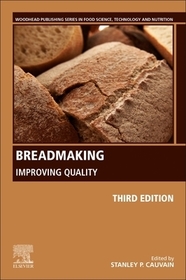
Breadmaking
Improving Quality
Sorozatcím: Woodhead Publishing Series in Food Science, Technology and Nutrition;
-
10% KEDVEZMÉNY?
- A kedvezmény csak az 'Értesítés a kedvenc témákról' hírlevelünk címzettjeinek rendeléseire érvényes.
- Kiadói listaár EUR 305.00
-
126 498 Ft (120 475 Ft + 5% áfa)
Az ár azért becsült, mert a rendelés pillanatában nem lehet pontosan tudni, hogy a beérkezéskor milyen lesz a forint árfolyama az adott termék eredeti devizájához képest. Ha a forint romlana, kissé többet, ha javulna, kissé kevesebbet kell majd fizetnie.
- Kedvezmény(ek) 10% (cc. 12 650 Ft off)
- Kedvezményes ár 113 849 Ft (108 428 Ft + 5% áfa)
Iratkozzon fel most és részesüljön kedvezőbb árainkból!
Feliratkozom
126 498 Ft

Beszerezhetőség
Megrendelésre a kiadó utánnyomja a könyvet. Rendelhető, de a szokásosnál kicsit lassabban érkezik meg.
Why don't you give exact delivery time?
A beszerzés időigényét az eddigi tapasztalatokra alapozva adjuk meg. Azért becsült, mert a terméket külföldről hozzuk be, így a kiadó kiszolgálásának pillanatnyi gyorsaságától is függ. A megadottnál gyorsabb és lassabb szállítás is elképzelhető, de mindent megteszünk, hogy Ön a lehető leghamarabb jusson hozzá a termékhez.
A termék adatai:
- Kiadás sorszáma 3
- Kiadó Elsevier Science
- Megjelenés dátuma 2020. november 26.
- ISBN 9780081025192
- Kötéstípus Puhakötés
- Terjedelem766 oldal
- Méret 228x152 mm
- Súly 1220 g
- Nyelv angol 90
Kategóriák
Hosszú leírás:
Bread Making: Improving Quality quickly established itself as an essential purchase for baking professionals and researchers in this area. Fully revised and updated and with new chapters on Flour Lipids, and the dietary and nutritional quality of bread, this new edition provides readers with the information they need on the latest developments in bread making science and practice
The book opens with two introductory chapters providing an overview of the breadmaking process. Part one focuses on the impacts of wheat and flour quality on bread, covering topics such as wheat chemistry, wheat starch structure, grain quality assessment, milling and wheat breeding. Part two covers dough development and bread ingredients, with chapters on dough aeration and rheology, the use of redox agents and enzymes in breadmaking and water control, among other topics. In part three, the focus shifts to bread sensory quality, shelf life and safety. Topics covered include bread aroma, staling and contamination. Finally, part four looks at particular bread products such as high fiber breads, those made from partially baked and frozen dough and those made from non-wheat flours
With its distinguished editor and international team of contributors, Bread Making: Improving Quality, Third Edition, continues to serve as the standard reference for researchers and professionals in the bread industry and all those involved in academic research on breadmaking science and practice.
TöbbTartalomjegyzék:
1.ï¿1⁄2An Introduction and Overview of Breadmaking
Part One: Wheat and Flour Quality
2.ï¿1⁄2The Chemistry and Biochemistry of Wheat
3.ï¿1⁄2Techniques for Analyzing Wheat Proteins
4.ï¿1⁄2Wheat Proteins and Bread Quality
5.ï¿1⁄2Wheat Starch Structure and Bread Quality
6.ï¿1⁄2Flour lipids, fats and emulsifiers
7.ï¿1⁄2Milling and Flour Quality
8.ï¿1⁄2Wheat Breeding and Quality Evaluation
9.ï¿1⁄2Improving Wheat Protein Quality for Breadmaking: the Role of Biotechnology
10.ï¿1⁄2Acrylamide
Part Two: Dough Development and Particular Bread Ingredients
11.ï¿1⁄2Bread Aeration and Dough Rheology: An Overview
12.ï¿1⁄2The Molecular Basis of Bread Dough Rheology
13.ï¿1⁄2Redox Agents and Other Improvers in Breadmaking
14.ï¿1⁄2Applications of Enzymes in Breadmaking
15.ï¿1⁄2Water Control in Breadmaking
Part Three: Bread Sensory Quality, Shelf Life, and Safety
16.ï¿1⁄2Bread Aroma
17.ï¿1⁄2Application of Texture Analysis to Dough and Bread
18.ï¿1⁄2Mould Prevention in Bread
19.ï¿1⁄2Bread Staling
Part Four: Particular Bread Products
20.ï¿1⁄2Improving the Quality of Bread Made from Partially Baked, Refrigerated, and Frozen Dough
21.ï¿1⁄2Improved Nutritional and Dietary Quality of Breads
22.ï¿1⁄2The Quality of Breads Made with Non-wheat Flours
23.ï¿1⁄2Formulating breads for specific dietary requirements
24.ï¿1⁄2The future for breadmaking

