

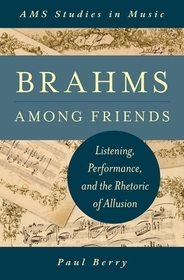
Brahms Among Friends
Listening, Performance, and the Rhetoric of Allusion
Sorozatcím: AMS Studies in Music;
-
10% KEDVEZMÉNY?
- A kedvezmény csak az 'Értesítés a kedvenc témákról' hírlevelünk címzettjeinek rendeléseire érvényes.
- Kiadói listaár GBP 65.00
-
31 053 Ft (29 575 Ft + 5% áfa)
Az ár azért becsült, mert a rendelés pillanatában nem lehet pontosan tudni, hogy a beérkezéskor milyen lesz a forint árfolyama az adott termék eredeti devizájához képest. Ha a forint romlana, kissé többet, ha javulna, kissé kevesebbet kell majd fizetnie.
- Kedvezmény(ek) 10% (cc. 3 105 Ft off)
- Kedvezményes ár 27 948 Ft (26 618 Ft + 5% áfa)
Iratkozzon fel most és részesüljön kedvezőbb árainkból!
Feliratkozom
31 053 Ft

Beszerezhetőség
Megrendelésre a kiadó utánnyomja a könyvet. Rendelhető, de a szokásosnál kicsit lassabban érkezik meg.
Why don't you give exact delivery time?
A beszerzés időigényét az eddigi tapasztalatokra alapozva adjuk meg. Azért becsült, mert a terméket külföldről hozzuk be, így a kiadó kiszolgálásának pillanatnyi gyorsaságától is függ. A megadottnál gyorsabb és lassabb szállítás is elképzelhető, de mindent megteszünk, hogy Ön a lehető leghamarabb jusson hozzá a termékhez.
A termék adatai:
- Kiadó OUP USA
- Megjelenés dátuma 2014. szeptember 11.
- ISBN 9780199982646
- Kötéstípus Keménykötés
- Terjedelem400 oldal
- Méret 160x236x33 mm
- Súly 726 g
- Nyelv angol
- Illusztrációk 131 music examples 0
Kategóriák
Rövid leírás:
Brahms Among Friends identifies patterns of listening, performance, and composition among friends of Johannes Brahms and explores how those patterns informed the creation and reception of his music in intimate genres.
TöbbHosszú leírás:
Brahms Among Friends identifies patterns of listening, performance, and composition among close friends of Johannes Brahms and explores how those patterns informed the creation and reception of his music in the intimate genres of song, sonata, trio, and piano miniature. Among the tangled threads of counterpoint and circumstance that bound Brahms to his acquaintances was the technique of allusive musical borrowing, whereby a brief passage from a familiar work was drawn into the fabric of a new composition. For the specific listeners whose habits of mind and musicianship he knew best, allusive borrowings could become rhetorically charged gestures, persuasively revising the meanings his music conveyed and the interpretive strategies it invited.
Primary documents, original manuscripts, music-analytic comparison, and kinesthetic parameters experienced in the act of performance all work in tandem to support ten case studies in the interplay between Brahms's small-scale works and the women and men who encountered them before publication. Central characters include violinist Joseph Joachim, singers Amalie Joachim, Julius Stockhausen, and Agathe von Siebold, composers Heinrich and Elisabeth von Herzogenberg, and pianists Emma Engelmann and Clara Schumann. For these musicians and for the composer himself, Brahms's allusive music served a broad variety of emotional needs and interpersonal ends. Yet across diverse repertoire and interdisciplinary correlates ranging from ethnography to psychoanalysis, each case study furthers a single, underlying aim: Yet across diverse repertoire and interdisciplinary correlates ranging from ethnography to psychoanalysis, each case study furthers a single, underlying aim: to reconstruct the mutually dependent perspectives of historically situated agents and restore forgotten features of their communicative landscapes as bases for both musical and historical scrutiny.
Strongly recommended...
Tartalomjegyzék:
Introduction: Historiographies of Allusion
Part I: Occasional Lullabies
Chapter 1: Old Melodies, New Identities
Chapter 2: Lessons in Politics and Innuendo
Part II: Themes and Variations
Chapter 3: Emulation as Empathy
Chapter 4: Consequences of Criticism
Part III: Clara at the Keyboard
Chapter 5: Family Resemblances
Chapter 6: Shared Nostalgia
Chapter 7: Grief and Transformation
Part IV: Rhetorics of Closure
Chapter 8: Forests of the Heart
Chapter 9: Counterpoint and Catharsis
Chapter 10: Concealment as Self-Restraint
Bibliography

