

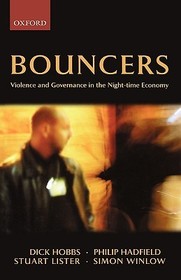
Bouncers
Violence and Governance in the Night-time Economy
Sorozatcím: Clarendon Studies in Criminology;
-
10% KEDVEZMÉNY?
- A kedvezmény csak az 'Értesítés a kedvenc témákról' hírlevelünk címzettjeinek rendeléseire érvényes.
- Kiadói listaár GBP 43.99
-
21 016 Ft (20 015 Ft + 5% áfa)
Az ár azért becsült, mert a rendelés pillanatában nem lehet pontosan tudni, hogy a beérkezéskor milyen lesz a forint árfolyama az adott termék eredeti devizájához képest. Ha a forint romlana, kissé többet, ha javulna, kissé kevesebbet kell majd fizetnie.
- Kedvezmény(ek) 10% (cc. 2 102 Ft off)
- Kedvezményes ár 18 914 Ft (18 014 Ft + 5% áfa)
Iratkozzon fel most és részesüljön kedvezőbb árainkból!
Feliratkozom
21 016 Ft

Beszerezhetőség
Megrendelésre a kiadó utánnyomja a könyvet. Rendelhető, de a szokásosnál kicsit lassabban érkezik meg.
Why don't you give exact delivery time?
A beszerzés időigényét az eddigi tapasztalatokra alapozva adjuk meg. Azért becsült, mert a terméket külföldről hozzuk be, így a kiadó kiszolgálásának pillanatnyi gyorsaságától is függ. A megadottnál gyorsabb és lassabb szállítás is elképzelhető, de mindent megteszünk, hogy Ön a lehető leghamarabb jusson hozzá a termékhez.
A termék adatai:
- Kiadó OUP Oxford
- Megjelenés dátuma 2003. március 20.
- ISBN 9780199252244
- Kötéstípus Keménykötés
- Terjedelem336 oldal
- Méret 224x145x22 mm
- Súly 496 g
- Nyelv angol 0
Kategóriák
Rövid leírás:
This book is the first attempt to understand Britain's night-time economy, the violence that pervades it, and the bouncers whose job it is to prevent it. Walk down any high street after dark and the shadows of bouncers will loom large, for they are the most visible form of control available in the youth-orientated zones of our cities after dark. Britain's rapidly expanding night-life is one of the country's most vibrant economic spheres, but it has created huge problems of violence and disorder.
Using ethnography, participant observation, and extensive interviews with all the main players, this controversial book charts the emergence of the bouncer as one of the most graphic symbols in the iconography of post industrial Britain.
Hosszú leírás:
In recent years, the expansion of night-time leisure has emerged as a key indicator of post-industrial urban prosperity, attracting investment, creating employment, and re-generating the built environment.
These leisure economies are youth-dominated, focusing upon the sale and consumption of alcohol. Unprecedented numbers of young people now flock to town centres that are crammed with bars, pubs, and clubs, and the resulting violent disorder has over run police resources that remain geared to the drinking patterns and alcohol cultures of previous generations.
Post-industrial re-structuring has spawned an increasingly complex mass of night-time leisure options through which numerous licit and illicit commercial opportunities flow. Yet, regardless of the fashionable and romantic notions of many contemporary urban theorists, it is alcohol, mass intoxication, and profit rather than 'cultural regeneration,' which lies at the heart of this rapidly expanding dimension of post-industrial urbanism.
Private security in the bulky form of bouncers fills the void left by the public police. These men (only 7% are women), whose activities are barely regulated by the State, are dominated by a powerful subculture rooted in routine violence and intimidation.
Using ethnography, participant observation, and extensive interviews with all the main players, this controversial book charts the emergence of the bouncer as one of the most graphic symbols in the iconography of post-industrial Britain.
Dick Hobb's research has always traversed the large distance between the criminal and the criminologist and his writing the even larger gap between the novelist and the academic. This has meant that his books are as full of characters as facts and of wry comment as dry analysis and Bouncers is no exception.
Tartalomjegyzék:
Let the Good Times Roll: Liminality and the Night-time Economy
After-Dark: 'Fun' and Control in the Industrial City
Post-Industrial Manchester: From Cotton to Carlsberg
Tommy Smith's Story: Four Decades on the Door
Russ's Bar: A Bouncer's Tale
A Word at the Door: Bouncers on their Work.
Dogs that Pass in the Night: Training Bouncers
Badging Up: Registering Bouncers
Market Force: Class, Violence, and Liminal Business on the Night-time Frontier
Conclusion.

