

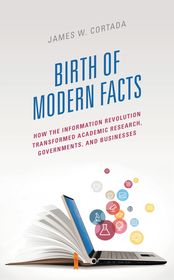
Birth of Modern Facts
How the Information Revolution Transformed Academic Research, Governments, and Businesses
-
20% KEDVEZMÉNY?
- A kedvezmény csak az 'Értesítés a kedvenc témákról' hírlevelünk címzettjeinek rendeléseire érvényes.
- Kiadói listaár GBP 28.99
-
13 088 Ft (12 465 Ft + 5% áfa)
Az ár azért becsült, mert a rendelés pillanatában nem lehet pontosan tudni, hogy a beérkezéskor milyen lesz a forint árfolyama az adott termék eredeti devizájához képest. Ha a forint romlana, kissé többet, ha javulna, kissé kevesebbet kell majd fizetnie.
- Kedvezmény(ek) 20% (cc. 2 618 Ft off)
- Kedvezményes ár 10 471 Ft (9 972 Ft + 5% áfa)
- A kedvezmény érvényes eddig: 2026. június 30.
Iratkozzon fel most és részesüljön kedvezőbb árainkból!
Feliratkozom
13 088 Ft

Beszerezhetőség
Megrendelésre a kiadó utánnyomja a könyvet. Rendelhető, de a szokásosnál kicsit lassabban érkezik meg.
Why don't you give exact delivery time?
A beszerzés időigényét az eddigi tapasztalatokra alapozva adjuk meg. Azért becsült, mert a terméket külföldről hozzuk be, így a kiadó kiszolgálásának pillanatnyi gyorsaságától is függ. A megadottnál gyorsabb és lassabb szállítás is elképzelhető, de mindent megteszünk, hogy Ön a lehető leghamarabb jusson hozzá a termékhez.
A termék adatai:
- Kiadó Bloomsbury Publishing (UK)
- Megjelenés dátuma 2026. február 19.
- ISBN 9798216449218
- Kötéstípus Puhakötés
- Terjedelem462 oldal
- Méret 228x148x26 mm
- Súly 660 g
- Nyelv angol
- Illusztrációk 19 b/w illustrations; 14 tables; 2 textboxes; 681
Kategóriák
Hosszú leírás:
For over twenty years, James W. Cortada has pioneered research into how information shapes society. In this book he tells the story of how information evolved since the mid-nineteenth century. Cortada argues that information increased in quantity, became more specialized by discipline (e.g., mathematics, science, political science), and more organized. Information increased in volume due to a series of innovations, such as the electrification of communications and the development of computers, but also due to the organization of facts and knowledge by discipline, making it easier to manage and access. He looks at what major disciplines have done to shape the nature of modern information, devoting chapters to the most obvious ones. Cortada argues that understanding how some features of information evolved is useful for those who work in subjects that deal with their very construct and application, such as computer scientists and those exploring social media and, most recently, history. The Birth of Modern Facts builds on Cortada's prior books examining how information became a central feature of modern society, most notably as a sequel to All the Facts: A History of Information in the United States since 1870 (OUP, 2016) and Building Blocks of Society: History, Information Ecosystems, and Infrastructures (R&L, 2021).
TöbbTartalomjegyzék:
Preface
1.How Librarians, Scholars, and the New Professions Defined Modern Information
2.Second Industrial Revolution Encounters Information
3.How Librarians Organized Information
4.Early Encounters by Computer Builders
5.Mathematicians and Statisticians Create New Tools
6.Scientists and Medical Experts Shape Information
7.New Business and Government Information Ecosystems
8.What Information Economists Created
9.Contributions of Political Scientists and Historians to Modern Information
10.How Information Evolved
Endnotes
Bibliographic Essay
Index

