

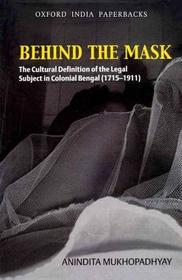
Behind the Mask
The Cultural Definition of the Legal Subject in Colonial Bengal (1715-1911)
-
10% KEDVEZMÉNY?
- A kedvezmény csak az 'Értesítés a kedvenc témákról' hírlevelünk címzettjeinek rendeléseire érvényes.
- Kiadói listaár GBP 11.99
-
5 413 Ft (5 155 Ft + 5% áfa)
Az ár azért becsült, mert a rendelés pillanatában nem lehet pontosan tudni, hogy a beérkezéskor milyen lesz a forint árfolyama az adott termék eredeti devizájához képest. Ha a forint romlana, kissé többet, ha javulna, kissé kevesebbet kell majd fizetnie.
- Kedvezmény(ek) 10% (cc. 541 Ft off)
- Kedvezményes ár 4 871 Ft (4 640 Ft + 5% áfa)
Iratkozzon fel most és részesüljön kedvezőbb árainkból!
Feliratkozom
5 413 Ft

Beszerezhetőség
Csak rendelésre kapható a kiadónál, kissé időigényes.
Why don't you give exact delivery time?
A beszerzés időigényét az eddigi tapasztalatokra alapozva adjuk meg. Azért becsült, mert a terméket külföldről hozzuk be, így a kiadó kiszolgálásának pillanatnyi gyorsaságától is függ. A megadottnál gyorsabb és lassabb szállítás is elképzelhető, de mindent megteszünk, hogy Ön a lehető leghamarabb jusson hozzá a termékhez.
A termék adatai:
- Kiadó OUP India
- Megjelenés dátuma 2013. október 31.
- ISBN 9780198089674
- Kötéstípus Keménykötés
- Terjedelem315 oldal
- Méret 220x142x17 mm
- Súly 314 g
- Nyelv angol 0
Kategóriák
Rövid leírás:
The book explores the complex inter-linkages between the formation of middle class identity, colonial legal discourse and class antagonism between late eighteenth and early twentieth century in Bengal.
TöbbHosszú leírás:
The book explores the complex inter-linkages between colonial legal discourse, class antagonism, and the formation of middle class identity between late eighteenth and early twentieth century in Bengal. It also examines the nature of colonial bureaucracy, bhadralok identitiy formation and criminality in Bengal. The colonial state had deployed its most powerful ideological and operation rationale-the Rule of Law-on the indigenous elite at the turn of the nineteenth century. This work addresses a fundamental discursive discontinuity when the Bengali bhadralok, a variegated, literate and self reflective social group, struggled to forge a new understanding of a thinking legal subject while negotiating with Western intellectual thought. It investigates the ambiguity of the bhadralok response to the courts and the jails. The discourse of superior bhadralok ethics and morals was juxtaposed against the chhotolok-who were devoid of such ethical values. This enabled the bhadralok to claim for themselves the position of the 'aware' legal subject as a class-a 'good' subject obedient to the dictates of the new rule of law, unlike the recalcitrant and ethically ill-equipped chhotolok. It also brings out how the colonial legal and penal institutions streamlined the identities of some sections of the lower castes into 'criminal classes'. The author also tries to highlight the social silence on gender female criminality.
TöbbTartalomjegyzék:
Acknowledgements
List of Tables
List of Abbreviations
Introduction
Official Discourse: The Creation of Categories and Spaces
Experiencing the New Order: In Search of an Identity, 1775-1890
The Making of the Mask, 1854-90
The Representation of Otherness
Cultural Affirmation of Non-Criminal Identity; Conclusion
Glossary
Bibliography
Index

