

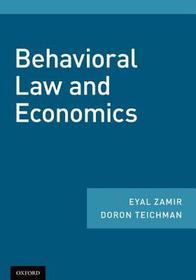
Behavioral Law and Economics
-
10% KEDVEZMÉNY?
- A kedvezmény csak az 'Értesítés a kedvenc témákról' hírlevelünk címzettjeinek rendeléseire érvényes.
- Kiadói listaár GBP 58.00
-
26 187 Ft (24 940 Ft + 5% áfa)
Az ár azért becsült, mert a rendelés pillanatában nem lehet pontosan tudni, hogy a beérkezéskor milyen lesz a forint árfolyama az adott termék eredeti devizájához képest. Ha a forint romlana, kissé többet, ha javulna, kissé kevesebbet kell majd fizetnie.
- Kedvezmény(ek) 10% (cc. 2 619 Ft off)
- Kedvezményes ár 23 568 Ft (22 446 Ft + 5% áfa)
Iratkozzon fel most és részesüljön kedvezőbb árainkból!
Feliratkozom
26 187 Ft

Beszerezhetőség
Megrendelésre a kiadó utánnyomja a könyvet. Rendelhető, de a szokásosnál kicsit lassabban érkezik meg.
Why don't you give exact delivery time?
A beszerzés időigényét az eddigi tapasztalatokra alapozva adjuk meg. Azért becsült, mert a terméket külföldről hozzuk be, így a kiadó kiszolgálásának pillanatnyi gyorsaságától is függ. A megadottnál gyorsabb és lassabb szállítás is elképzelhető, de mindent megteszünk, hogy Ön a lehető leghamarabb jusson hozzá a termékhez.
A termék adatai:
- Kiadó OUP USA
- Megjelenés dátuma 2018. szeptember 27.
- ISBN 9780190901356
- Kötéstípus Puhakötés
- Terjedelem640 oldal
- Méret 178x251x35 mm
- Súly 1116 g
- Nyelv angol 0
Kategóriák
Rövid leírás:
This book offers a state-of-the-art overview of behavioral law and economics surveying the entire body of psychological research that lies at the basis of behavioral analysis of law, and critically evaluating the core methodological questions. It discusses the fundamental normative questions stemming from the psychological findings on bounded rationality, and explores their implications for setting the law's goals and designing the means to attain them.
TöbbHosszú leírás:
In the past few decades, economic analysis of law has been challenged by a growing body of experimental and empirical studies that attest to prevalent and systematic deviations from the assumptions of economic rationality. While the findings on bounded rationality and heuristics and biases were initially perceived as antithetical to standard economic and legal-economic analysis, over time they have been largely integrated into mainstream economic analysis, including economic analysis of law. Moreover, the impact of behavioral insights has long since transcended purely economic analysis of law: in recent years, the behavioral movement has become one of the most influential developments in legal scholarship in general.
Behavioral Law and Economics offers a state-of-the-art overview of the field. Eyal Zamir and Doron Teichman survey the entire body of psychological research that lies at the basis of behavioral analysis of law, and critically evaluate the core methodological questions of this area of research. Following this, the book discusses the fundamental normative questions stemming from the psychological findings on bounded rationality, and explores their implications for setting the law's goals and designing the means to attain them. The book then provides a systematic and critical examination of the contributions of behavioral studies to all major fields of law including: property, contracts, consumer protection, torts, corporate, securities regulation, antitrust, administrative, constitutional, international, criminal, and evidence law, as well as to the behavior of key players in the legal arena: litigants and judicial decision-makers.
This book offers a fresh view and overview of behavioural law and economics. It surveys the entire body of psychological research that lies at the basis of behavioural analysis of law and critically evaluates the core methodological questions.
Tartalomjegyzék:
Preface
Introduction
Part I: Economic and Psychological Background
Chapter 1. Economic Analysis of Law: An Overview
Chapter 2. Behavioral Studies
Part II: Behavioral Law and Economics: A Synopsis
Chapter 3. An Overview of Behavioral Law and Economics
Chapter 4. Normative Implications
Chapter 5. Behavioral Insights and Basic Features of the Law
Part III: Private and Commercial Law
Chapter 6. Property Law
Chapter 7. Contract Law
Chapter 8. Consumer Contracts
Chapter 9. Tort Law
Chapter 10. Commercial Law: Corporate Law, Securities Regulation, and Antitrust
Part IV: Public Law
Chapter 11. Administrative, Constitutional, and International Law
Chapter 12: Criminal Law and Enforcement
Chapter 13. Tax Law
Part V: The Legal Process
Chapter 14. Litigants' Behavior
Chapter 15. Judicial Decision-Making
Chapter 16. Evidence Law
Index

