

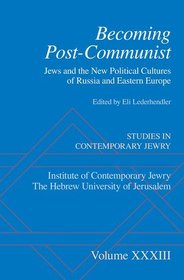
Becoming Post-Communist
Jews And The New Political Cultures Of Russia And Eastern Europe
Sorozatcím: STUDIES IN CONTEMPORARY JEWRY;
-
10% KEDVEZMÉNY?
- A kedvezmény csak az 'Értesítés a kedvenc témákról' hírlevelünk címzettjeinek rendeléseire érvényes.
- Kiadói listaár GBP 94.00
-
44 908 Ft (42 770 Ft + 5% áfa)
Az ár azért becsült, mert a rendelés pillanatában nem lehet pontosan tudni, hogy a beérkezéskor milyen lesz a forint árfolyama az adott termék eredeti devizájához képest. Ha a forint romlana, kissé többet, ha javulna, kissé kevesebbet kell majd fizetnie.
- Kedvezmény(ek) 10% (cc. 4 491 Ft off)
- Kedvezményes ár 40 418 Ft (38 493 Ft + 5% áfa)
Iratkozzon fel most és részesüljön kedvezőbb árainkból!
Feliratkozom
44 908 Ft

Beszerezhetőség
Becsült beszerzési idő: Várható beérkezés: 2026. január vége.
A Prosperónál jelenleg nincsen raktáron.
Why don't you give exact delivery time?
A beszerzés időigényét az eddigi tapasztalatokra alapozva adjuk meg. Azért becsült, mert a terméket külföldről hozzuk be, így a kiadó kiszolgálásának pillanatnyi gyorsaságától is függ. A megadottnál gyorsabb és lassabb szállítás is elképzelhető, de mindent megteszünk, hogy Ön a lehető leghamarabb jusson hozzá a termékhez.
A termék adatai:
- Kiadó OUP USA
- Megjelenés dátuma 2023. március 28.
- ISBN 9780197687215
- Kötéstípus Keménykötés
- Terjedelem304 oldal
- Méret 164x236x23 mm
- Súly 590 g
- Nyelv angol
- Illusztrációk 26 b/w figures 449
Kategóriák
Rövid leírás:
The closing decade of the 20th century witnessed dramatic upheavals across landscapes that had once housed most of the world's Jewish population: the overturning of the East European Communist governments and the fall of the USSR, accompanied by a major Jewish emigration movement. The experts contributing to this volume apply interdisciplinary approaches to analyze and interpret the shifting post-communist social and political realities and aid our understanding of recent events.
TöbbHosszú leírás:
The closing decade of the 20th century witnessed dramatic upheavals across landscapes that had, until 1939, housed most of the world's Jewish population: the overturning of the East European Communist governments and the fall of the USSR, accompanied by a major Jewish emigration movement. The legacy of the Jewish presence in those countries, and the ways in which it became enmeshed in the quest by people of the region--Jews and non-Jews alike--to secure their future, highlights fundamental issues about the politics of memory, national identity, and the relative stability of regimes in the region.
If those questions were important even before the Russian invasion of Ukraine in 2022, understanding their implications now seems even more crucial. In a field fraught with conflicting narratives, the challenges of social and political reconstruction are primary concerns for peoples and governments. The experts contributing to this volume apply interdisciplinary approaches to analyze and interpret a multiplicity of post-communist social realities and aid our understanding of recent events.
Tartalomjegyzék:
Symposium
Becoming Post-Communist: Jews and the New Political Cultures of Russia and Eastern Europe
Eli Lederhendler, Introduction: Jews, Communism and Post-Communism: Short and Long-term Aftereffects
Jelena Subotic, Historical Memory and Antisemitism in Post-Communist East Central Europe
Jonathan Zisook, The Politics of Holocaust Memory in Central and Eastern Europe: Contemporary Poland as a Comparative Case Study
András Kovács, Jewish Revival in Post-Communist Hungary: Expectations and Reality
Marcin Wodzinski, Prospects for Jewish Studies in Poland: An Update for a New Decade
Vladimir Levin, Jewish Cultural Heritage in the USSR and after Its Collapse
Mark Tolts, Russian Jewry in the Post-Soviet Era: Socio-Demographic Transformation
Semion Goldin, Becoming Jews: The Petersburg Jewish University in the 1990s
Essay
Janiv Stamberger, Bridging the Divide: Philanthropy as an Intersection Point in Belgian Jewish Society during the Interwar Period
Review Essay
Shulamit Volkov, Antisemitism in Context: Three Recent Volumes
Book Reviews (arranged by subject)
Antisemitism, Holocaust, and Genocide
Kiril Feferman, If we had wings we would fly to you: A Soviet Jewish Family Faces Destruction, 1941-42, Eliyana R. Adler
Sol Goldberg, Scott Ury, and Kalman Weiser (eds.), Key Concepts in the Study of Antisemitism, Shulamit Volkov
Abigail Green and Simon Levis Sullam (eds.), Jews, Liberalism, Antisemitism: A Global History, Shulamit Volkov
Erin McGlothlin, Brad Prager, and Markus Zisselberger (eds.), The Construction of Testimony: Claude Lanzmann's Shoah and Its Outtakes, Erez Pery
Thomas Pegelow Kaplan and Wolf Gruner (eds.), Resisting Persecution: Jews and Their Petitions during the Holocaust, David Silberklang
Scott Ury and Guy Miron (eds.), Antishemiyut: bein musag histori lesiah tziburi (Antisemitism: Historical Concept, Public Discourse), Shulamit Volkov
Cultural Studies, Literature, and Religion
Steven E. Aschheim, Fragile Spaces: Forays into Jewish Memory, European History, and Complex Identities, Jeffrey A. Grossman
Manuela Consonni and Vivian Liska (eds.), Sartre, Jews, and the Other: Rethinking Antisemitism, Race, and Gender, Norman J.W. Goda
Dina Danon, The Jews of Ottoman Izmir: A Modern History, Esra Almas
Daniela Flesler and Adrián Pérez Melgosa, The Memory Work of Jewish Spain, Martina L. Weisz
Malte Fuhrmann, Port Cities of the Eastern Mediterranean: Urban Culture in the Late Ottoman Empire, Esra Almas
Eran Kaplan, Projecting the Nation: History and Ideology on the Israeli Screen, Liat Steir-Livny
Louis Kaplan, At Wit's End: The Deadly Discourse on the Jewish Joke, Peter Jelavich
James McAuley, The House of Fragile Things: Jewish Art Collectors and the Fall of France, Richard I. Cohen
Mirjam Rajner, Fragile Images: Jews and Art in Yugoslavia, 1918-1945, Andrew Wachtel
Diego Rotman, The Yiddish Stage as a Temporary Home: Dzigan and Shumacher's Satirical Theater (1927-1980), trans. Rebecca Wolpe, Vassili Schedrin
Lynne M. Swarts, Gender, Orientalism and the Jewish Nation: Women in the Work of Ephraim Moses Lilien at the German Fin de Siecle, Lauren B. Strauss
Edmund de Waal, Letters to Camondo, Richard I. Cohen
History, Biography, Social and Gender Studies
Barry R. Chiswick, Jews at Work: Their Economic Progress in the American Labor Market, Paul Burstein
Zev Eleff, Authentically Orthodox: A Tradition-bound Faith in American Life, Samuel Heilman
Elisabeth Gallas, A Mortuary of Books: The Rescue of Jewish Culture after the Holocaust, trans. Alex Skinner, David E. Fishman
Dvora Hacohen, To Repair a Broken World: The Life of Henrietta Szold, Mira Katzburg-Yungman
Rachel Manekin, The Rebellion of the Daughters: Jewish Women Runaways in Habsburg Galicia, Michael L. Miller
Rafael Medoff, The Jews Should Keep Quiet: Franklin D. Roosevelt, Rabbi Stephen S. Wise, and the Holocaust, Stephen J. Whitfield
Michael A. Meyer, Rabbi Leo Baeck: Living a Religious Imperative in Troubled Times, Steven E. Aschheim
Sharon Pardo and Hila Zahavi (eds.), The Jewish Contribution to European Integration, Michael Berkowitz
Joel Perlmann, America Classifies the Immigrants: From Ellis Island to the 2020 Census, Barry R. Chiswick
Anne C. Schenderlein, Germany on Their Minds: German Jewish Refugees in the United States and Their Relationships with Germany, 1938-1988, Ofer Ashkenazi
Harvey Schwartz (ed.), The Jewish Thought and Psychoanalysis Lectures, Shmuel Erlich
Augusto Segre, Stories of Jewish Life: Casale Monferrato-Rome-Jerusalem, 1876-1985, trans. Steve Siporin, Luisa Levi D'Ancona Modena
Nancy Sinkoff, From Left to Right: Lucy S. Dawidowicz, the New York Intellectuals and the Politics of Jewish History, Jeffrey S. Gurock
Stephen J. Whitfield, Learning on the Left: Political Profiles of Brandeis University, David Ellenson
Steven J. Zipperstein, Pogrom: Kishinev and the Tilt of History, Francois Guesnet
Zionism, Israel, and the Middle East
Yuval Evri, Hashivah leAndalus: mahlokot 'al tarbut vezehut yehudit-sefaradit bein 'araviyut le'ivriyut (The Return to Al-Andalus: Disputes over Sephardic Culture and Identity between Arabic and Hebrew), Menachem Klein
Tal Elmaliach, Hakibbutz Ha'artzi, Mapam, and the Demise of the Israeli Labor Movement, trans. Haim Watzman, Yechiam Weitz
Sharon Geva, Haishah mah omeret? Nashim beyisrael bishnot hamedinah harishonot (Women in the State of Israel: The Early Years), Orit Rozin
Walter L. Hixson, Israel's Armor: The Israel Lobby and the First Generation of the Palestine Conflict, Joseph Heller
Nir Kedar, Law and Identity in Israel: A Century of Debate, trans. Haim Watzman, Yehudit Dori Deston
Fredrik Meiton, Electrical Palestine: Capital and Technology from Empire to Nation, Yossi Ben Artzi
Yonatan Mendel, Safah mihutz limkomah: orientalizm, modi'in veha'aravit beyisrael (Language out of Place: Orientalism, Intelligence and Arabic in Israel), Menachem Klein
Rachel Rojanski, Yiddish in Israel: A History, Yaad Biran
Marc Volovici, German as a Jewish Problem: The Language Politics of Jewish Nationalism, Moshe Zimmermann
Note on Editorial Policy

