

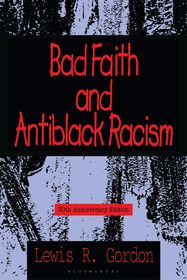
Bad Faith and Antiblack Racism
30th Anniversary Edition
-
20% KEDVEZMÉNY?
- A kedvezmény csak az 'Értesítés a kedvenc témákról' hírlevelünk címzettjeinek rendeléseire érvényes.
- Kiadói listaár GBP 28.99
-
13 088 Ft (12 465 Ft + 5% áfa)
Az ár azért becsült, mert a rendelés pillanatában nem lehet pontosan tudni, hogy a beérkezéskor milyen lesz a forint árfolyama az adott termék eredeti devizájához képest. Ha a forint romlana, kissé többet, ha javulna, kissé kevesebbet kell majd fizetnie.
- Kedvezmény(ek) 20% (cc. 2 618 Ft off)
- Kedvezményes ár 10 471 Ft (9 972 Ft + 5% áfa)
- A kedvezmény érvényes eddig: 2026. június 30.
Iratkozzon fel most és részesüljön kedvezőbb árainkból!
Feliratkozom
13 088 Ft

Beszerezhetőség
Becsült beszerzési idő: A Prosperónál jelenleg nincsen raktáron, de a kiadónál igen. Beszerzés kb. 3-5 hét..
A Prosperónál jelenleg nincsen raktáron.
Why don't you give exact delivery time?
A beszerzés időigényét az eddigi tapasztalatokra alapozva adjuk meg. Azért becsült, mert a terméket külföldről hozzuk be, így a kiadó kiszolgálásának pillanatnyi gyorsaságától is függ. A megadottnál gyorsabb és lassabb szállítás is elképzelhető, de mindent megteszünk, hogy Ön a lehető leghamarabb jusson hozzá a termékhez.
A termék adatai:
- Kiadás sorszáma Second Edition, New Edition, New edition
- Kiadó Bloomsbury Publishing (UK)
- Megjelenés dátuma 2026. február 19.
- Kötetek száma Paperback
- ISBN 9781538179604
- Kötéstípus Puhakötés
- Terjedelem376 oldal
- Méret 224x152x22 mm
- Súly 560 g
- Nyelv angol 681
Kategóriák
Rövid leírás:
This is the 30th Anniversary Edition of Lewis R. Gordon's classic existential phenomenological inaugural work, Bad Faith and Antiblack Racism.
TöbbHosszú leírás:
In this contemporary classic, Lewis Gordon presents his iconic, detailed existential phenomenological investigation of antiblack racism as a form of Sartrean bad faith. Bad faith, the attitude in which human beings attempt to evade freedom and responsibility, is treated as a constant possibility of human existence. Antiblack racism, the attitude and practice that involves the construction of black people as fundamentally inferior and subhuman, is examined as an effort to evade the responsibilities of a human and humane world. Gordon argues that the concept of bad faith militates against any human science that is built upon a theory of human nature and as such offers an analysis of antiblack racism that stands as a challenge to our ordinary assumptions of what it means to be human.
A foundational text in black existentialism, this 30th anniversary edition includes a substantial introduction by Mabogo Moreto address the ongoing importance of Gordon's thought in critiquing and resisting racist bad faith in our contemporary moment.
Tartalomjegyzék:
"
Prefaceby Lewis Gordon
Introduction by Mabogo P. More
Introduction: Why Bad Faith?
Part 1: Bad Faith
A ""Determined"" Attitude That Involves Lying to Ourselves
The Irony of Belief
Anguish
The Elusiveness of Transcendence and the Comfort of Facticity
What Am I to Me?
Taking Ourselves Too Seriously
The Body in Bad Faith
""Strong"" and ""Weak"" Bad Faith
Some Critical Remarks
How Is Bad Faith Possible?
The Question of Authenticity
Part 2: Logic of Racism, Racist Logic
A Recent Theory
Racialism, Racism, Racialists, and Racists
Affective Dimensions of Racism and Race
Part 3: Antiblack Racism
Racism and Antiblack Racism
White and Black Bodies in Bad Faith
Black Antiblackness in an Antiblack World
Exoticism: Antiblackness Under the Guise of Love
Effeminacy: The Quality of Black Beings
Antiblack Racism and Ontology
Part 4: ""God"" in an Antiblack World
An Antiblack Cosmogony
""Is God a White Racist?""
The White God and the Black Sufferer
Ultimate Desire and Authenticity in an Antiblack World
To Be Black, Faithful, and Suffering
Part 5: Critical Encounters
""I-Thou""
Ethical Concerns
Deconstruction
Marxism
Conclusion: The Living Dead
Notes
Bibliography
Index

