

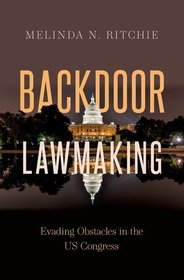
Backdoor Lawmaking
Evading Obstacles in the US Congress
-
10% KEDVEZMÉNY?
- A kedvezmény csak az 'Értesítés a kedvenc témákról' hírlevelünk címzettjeinek rendeléseire érvényes.
- Kiadói listaár GBP 68.00
-
30 702 Ft (29 240 Ft + 5% áfa)
Az ár azért becsült, mert a rendelés pillanatában nem lehet pontosan tudni, hogy a beérkezéskor milyen lesz a forint árfolyama az adott termék eredeti devizájához képest. Ha a forint romlana, kissé többet, ha javulna, kissé kevesebbet kell majd fizetnie.
- Kedvezmény(ek) 10% (cc. 3 070 Ft off)
- Kedvezményes ár 27 632 Ft (26 316 Ft + 5% áfa)
Iratkozzon fel most és részesüljön kedvezőbb árainkból!
Feliratkozom
30 702 Ft

Beszerezhetőség
Megrendelésre a kiadó utánnyomja a könyvet. Rendelhető, de a szokásosnál kicsit lassabban érkezik meg.
Why don't you give exact delivery time?
A beszerzés időigényét az eddigi tapasztalatokra alapozva adjuk meg. Azért becsült, mert a terméket külföldről hozzuk be, így a kiadó kiszolgálásának pillanatnyi gyorsaságától is függ. A megadottnál gyorsabb és lassabb szállítás is elképzelhető, de mindent megteszünk, hogy Ön a lehető leghamarabb jusson hozzá a termékhez.
A termék adatai:
- Kiadó OUP USA
- Megjelenés dátuma 2023. november 21.
- ISBN 9780197670484
- Kötéstípus Keménykötés
- Terjedelem266 oldal
- Méret 156x235x20 mm
- Súly 508 g
- Nyelv angol 456
Kategóriák
Rövid leírás:
Civics textbooks focus on how Congress makes policy through the legislative process, but the reality is that members of Congress have limited opportunities to advance their policy priorities. In fact, less than five percent of the bills that are introduced in Congress become law. What strategies do lawmakers have for navigating obstacles in Congress? In this book, Melinda N. Ritchie reveals how members of Congress use the federal bureaucracy as a backdoor for policymaking. Drawing on an original dataset constructed from records obtained under the Freedom of Information Act, Ritchie traces the interactions between members of Congress and federal agencies to illustrate how these communications function as part of a lawmaker's overarching strategy for policymaking.
TöbbHosszú leírás:
Civics textbooks focus on how Congress makes policy through the legislative process, but the reality is that members of Congress have limited opportunities to advance their policy priorities. In fact, less than five percent of the bills that are introduced in Congress become law. Even the most tenacious legislators are confronted by bicameralism, partisan gridlock, chamber procedures, leadership's control of the agenda, and the diverse interests of 534 other members of Congress. What strategies do lawmakers have for navigating these challenges?
In this book, Melinda N. Ritchie reveals how members of Congress use the federal bureaucracy as a backdoor for policymaking. Today, more law in the United States is made by unelected bureaucrats through federal agency regulations than with congressional statute. Ritchie argues that the bureaucracy's growing role in policymaking offers lawmakers a discreet way to represent controversial interests outside of the formal constraints of Congress. Lawmakers overcome obstacles in the legislative process by substituting agency regulations for legislation and pressuring agencies to make policy changes that would not pass Congress.
Drawing on an original dataset constructed from records obtained under the Freedom of Information Act, Ritchie traces the interactions between members of Congress and federal agencies to illustrate how these communications function as part of a lawmaker's overarching strategy for policymaking. Original and timely, Backdoor Lawmaking explains how members of Congress exploit the separation of powers and evade the lawmaking process established in the US Constitution.
This book lifts the veil on one aspect of the reality of lawmaking in the US...Ritchie's book is an instructive read.
Tartalomjegyzék:
Acknowledgments
List of Figures
List of Tables
1. Introduction
2. A Theory of Back-Channel Policymaking
3. The Freedom of Information Act and the War against
Transparency
4. The Nature of Inter-Branch Policy Communication
5. Misconceptions about Inter-Branch Relations
6. The Bureaucracy: Congress's Backdoor to Policy Influence
7. Back-Channel Representation
8. Congressional Access and Influence in the Bureaucracy
9. Conclusion
Notes
Index

