

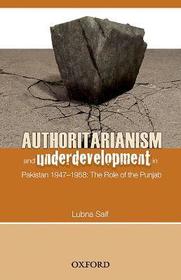
Authoritarianism and Underdevelopment
Pakistan (1947-58): The Role of Punjab
-
10% KEDVEZMÉNY?
- A kedvezmény csak az 'Értesítés a kedvenc témákról' hírlevelünk címzettjeinek rendeléseire érvényes.
- Kiadói listaár USD 13.00
-
4 299 Ft (4 095 Ft + 5% áfa)
Az ár azért becsült, mert a rendelés pillanatában nem lehet pontosan tudni, hogy a beérkezéskor milyen lesz a forint árfolyama az adott termék eredeti devizájához képest. Ha a forint romlana, kissé többet, ha javulna, kissé kevesebbet kell majd fizetnie.
- Kedvezmény(ek) 10% (cc. 430 Ft off)
- Kedvezményes ár 3 870 Ft (3 686 Ft + 5% áfa)
Iratkozzon fel most és részesüljön kedvezőbb árainkból!
Feliratkozom
4 299 Ft

Beszerezhetőség
Becsült beszerzési idő: A Prosperónál jelenleg nincsen raktáron, de a kiadónál igen. Beszerzés kb. 3-5 hét..
A Prosperónál jelenleg nincsen raktáron.
Why don't you give exact delivery time?
A beszerzés időigényét az eddigi tapasztalatokra alapozva adjuk meg. Azért becsült, mert a terméket külföldről hozzuk be, így a kiadó kiszolgálásának pillanatnyi gyorsaságától is függ. A megadottnál gyorsabb és lassabb szállítás is elképzelhető, de mindent megteszünk, hogy Ön a lehető leghamarabb jusson hozzá a termékhez.
A termék adatai:
- Kiadó OUP Pakistan
- Megjelenés dátuma 2010. június 17.
- ISBN 9780195477030
- Kötéstípus Keménykötés
- Terjedelem350 oldal
- Méret 225x149x22 mm
- Súly 534 g
- Nyelv angol 0
Kategóriák
Hosszú leírás:
This book has focused on the dialectic between state construction and the political process in Pakistan in the first decade of its independence. Using Dependency Paradigm as the evaluation tool, it examines the international political and economic factors, which in alliance with the domestic and regional factors shaped the structure of the Pakistani state according to the interests of the players of the neo-colonial world in the Cold War era.
The first decade of Pakistan's history (1947-1958) produced developments of great significance for the construction of the post-colonial state that needs to be examined in the context of Cold War era. It was during this period that democratic institutions were destroyed and authoritarianism was consolidated, which generated underdevelopment, and Pakistan took the shape of a 'client' state of the United States. These developments concluded in the first direct military rule in 1958, and since
then the military intervention in political domain has become a permanent feature of Pakistan's life at the cost of evolution of civil society and participatory institutions. An analytical study of the formative years of Pakistan in the context of 'dependency paradigm' may provide new insights for
understanding the broader issues of military intervention in politics and the authoritarian nature of the state and its links with underdevelopment in the Third World, particularly in South Asia.
Tartalomjegyzék:
List of Tables
Abbreviations
Acknowledgements
Introduction
Colonial Capitalism
Constructing the Post-Colonial State
Emergence of Institutional Imbalance-Manipulating Powers of International Connections
Destruction of Democracy and Consolidation of an Authoritarian State
Authoritarianism and Underdevelopment
Conclusion
Notes
Select Bibliography
Index

