

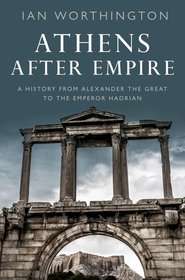
Athens After Empire
A History from Alexander the Great to the Emperor Hadrian
-
10% KEDVEZMÉNY?
- A kedvezmény csak az 'Értesítés a kedvenc témákról' hírlevelünk címzettjeinek rendeléseire érvényes.
- Kiadói listaár GBP 21.99
-
9 928 Ft (9 455 Ft + 5% áfa)
Az ár azért becsült, mert a rendelés pillanatában nem lehet pontosan tudni, hogy a beérkezéskor milyen lesz a forint árfolyama az adott termék eredeti devizájához képest. Ha a forint romlana, kissé többet, ha javulna, kissé kevesebbet kell majd fizetnie.
- Kedvezmény(ek) 10% (cc. 993 Ft off)
- Kedvezményes ár 8 935 Ft (8 510 Ft + 5% áfa)
Iratkozzon fel most és részesüljön kedvezőbb árainkból!
Feliratkozom
9 928 Ft

Beszerezhetőség
Csak rendelésre kapható a kiadónál, kissé időigényes.
Why don't you give exact delivery time?
A beszerzés időigényét az eddigi tapasztalatokra alapozva adjuk meg. Azért becsült, mert a terméket külföldről hozzuk be, így a kiadó kiszolgálásának pillanatnyi gyorsaságától is függ. A megadottnál gyorsabb és lassabb szállítás is elképzelhető, de mindent megteszünk, hogy Ön a lehető leghamarabb jusson hozzá a termékhez.
A termék adatai:
- Kiadó OUP USA
- Megjelenés dátuma 2023. január 26.
- ISBN 9780197684764
- Kötéstípus Puhakötés
- Terjedelem424 oldal
- Méret 153x236x24 mm
- Súly 612 g
- Nyelv angol 274
Kategóriák
Rövid leírás:
Athens After Empire provides a detailed history of Athens and its constancy as a crucial part of the Mediterranean landscape. This new narrative history of post-Classical Athens extends the period of study and expands research into the areas of socio-cultural change.
TöbbHosszú leírás:
A major new history of Athens' remarkably long and influential life after the collapse of its empire.
To many the history of post-Classical Athens is one of decline. True, Athens hardly commanded the number of allies it had when hegemon of its fifth-century Delian League or even its fourth-century Naval Confederacy, and its navy was but a shadow of its former self. But Athens recovered from its perilous position in the closing quarter of the fourth century and became once again a player in Greek affairs, even during the Roman occupation. Athenian democracy survived and evolved, even through its dealings with Hellenistic Kings, its military clashes with Macedonia, and its alliance with Rome. Famous Romans, including Julius Caesar and Mark Antony, saw Athens as much more than an isolated center for philosophy. Athens After Empire offers a new narrative history of post-Classical Athens, extending the period down to the aftermath of Hadrian's reign.
Ian Worthington's Athens After Empire shows how there has been a tendency to fixate on the heyday of famous ancient cities while the events before or after have been unfairly and misleadingly eclipsed. Paul Cartledge's excellent Hellenistic and Roman Sparta presents how such an approach distorted Sparta's enduring importance. Now, Worthington's splendid, learned, and highly readable volume will achieve the same for Athens. Worthington's aim is to demonstrate that Athens did not fade away or drop off the historical radar or even decline into oblivion, and he successfully proves his thesis.
Tartalomjegyzék:
Preface
Maps
Introduction: "This is the City of Hadrian and not of Theseus"
1. Farewell to Freedom
2. Under The Puppet Ruler: Demetrius of Phalerum
3. Political and Civic Institutions
4. Demetrius "The Besieger" and Athens
5. Testing Macedonia
6. Independence Day
7. Enter Rome, Exit Macedonia
8.Being Free without Freedom
9. Social Life and Religion
10. Sulla's Sack of Athens
11. The End of "Hellenistic" Athens
12. Augustus and Athens
13. Tiberius to Hadrian
14. Building A New Horizon?
15. Hadrian's Arch
Timeline
Bibliography
Index

