

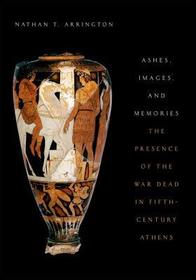
Ashes, Images, and Memories
The Presences of the War Dead in Fifth-Century Athens
-
10% KEDVEZMÉNY?
- A kedvezmény csak az 'Értesítés a kedvenc témákról' hírlevelünk címzettjeinek rendeléseire érvényes.
- Kiadói listaár GBP 43.99
-
19 861 Ft (18 915 Ft + 5% áfa)
Az ár azért becsült, mert a rendelés pillanatában nem lehet pontosan tudni, hogy a beérkezéskor milyen lesz a forint árfolyama az adott termék eredeti devizájához képest. Ha a forint romlana, kissé többet, ha javulna, kissé kevesebbet kell majd fizetnie.
- Kedvezmény(ek) 10% (kb. 1 986 Ft)
- Kedvezményes ár 17 875 Ft (17 024 Ft + 5% áfa)
Iratkozzon fel most és részesüljön kedvezőbb árainkból!
Feliratkozom
19 861 Ft

Beszerezhetőség
Megrendelésre a kiadó utánnyomja a könyvet. Rendelhető, de a szokásosnál kicsit lassabban érkezik meg.
Why don't you give exact delivery time?
A beszerzés időigényét az eddigi tapasztalatokra alapozva adjuk meg. Azért becsült, mert a terméket külföldről hozzuk be, így a kiadó kiszolgálásának pillanatnyi gyorsaságától is függ. A megadottnál gyorsabb és lassabb szállítás is elképzelhető, de mindent megteszünk, hogy Ön a lehető leghamarabb jusson hozzá a termékhez.
A termék adatai:
- Kiadó OUP USA
- Megjelenés dátuma 2019. január 10.
- ISBN 9780190936693
- Kötéstípus Puhakötés
- Terjedelem360 oldal
- Méret 163x231x15 mm
- Súly 635 g
- Nyelv angol
- Illusztrációk 85 illus. 0
Kategóriák
Rövid leírás:
This book explores how the institution of public burial for the war dead and images of the deceased in civic and sacred spaces fundamentally changed how Athenians conceived of military casualties, and traces the ways in which people responded through material culture.
TöbbHosszú leírás:
Ashes, Images, and Memories argues that the institution of public burial for the war dead and images of the deceased in civic and sacred spaces fundamentally changed how people conceived of military casualties in fifth-century Athens. In a period characterized by war and the threat of civil strife, the nascent democracy claimed the fallen for the city and commemorated them with rituals and images that shaped a civic ideology of struggle and self-sacrifice on behalf of a unified community.
While most studies of Athenian public burial have focused on discrete aspects of the institution, such as the funeral oration, this book broadens the scope. It examines the presence of the war dead in cemeteries, civic and sacred spaces, the home, and the mind, and underscores the role of material culture - from casualty lists to white-ground lekythoi-in mediating that presence. This approach reveals that public rites and monuments shaped memories of the war dead at the collective and individual levels, spurring private commemorations that both engaged with and critiqued the new ideals and the city's claims to the body of the warrior. Faced with a collective notion of "the fallen" families asserted the qualities, virtues, and family links of the individual deceased, and sought to recover opportunities for private commemoration and personal remembrance. Contestation over the presence and memory of the dead often followed class lines, with the elite claiming service and leadership to the community while at the same time reviving Archaic and aristocratic commemorative discourses. Although Classical Greek art tends to be viewed as a monolithic if evolving whole, this book depicts a fragmented and charged visual world.
Nathan Arrington's erudite and thoughtful book conjoins a mastery of social history, art history, and field archaeology to explain the role of commemorating war dead in Athenian cultural expression and political development. He offers new and convincing interpretations of the chronology and topography of public rituals honoring the fallen. This has big implications for rethinking the iconography and reception of major monuments and the relationship between war, memory, and democracy. While always sensitive to ancient cultural specificity, Arrington draws telling, and often haunting, parallels between the attempts of democracies ancient and modern to represent to themselves the sacrifice and irreplaceable loss of young men who die fulfilling the purposes of their country. This is a major contribution to the literature on war, art, memory, and ritual. It deserves a wide readership within and beyond ancient studies."
Tartalomjegyzék:
Acknowledgements
Introduction - "To see them so changed would be their death."
Chapter 1 - Mass Ashes: The Origins and Impact of an "Ancestral Custom"
Chapter 2 - The Topography and Phenomenology of the Public Cemetery
Chapter 3 - Naming the Dead: Casualty Lists and the Tenses of Commemoration
Chapter 4 - Sacred Space and the Fallen Warrior
Chapter 5 - Private Engagement with Civic Death: Portrait Statues, Votive Reliefs, and Wall Paintings
Chapter 6 - More Than a Name: Private Commemoration in Attic Cemeteries
Chapter 7 - The Limits of Commemoration
Conclusion
Bibliography
Index

