

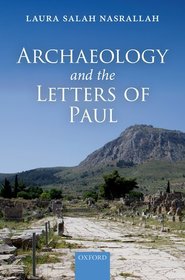
Archaeology and the Letters of Paul
-
10% KEDVEZMÉNY?
- A kedvezmény csak az 'Értesítés a kedvenc témákról' hírlevelünk címzettjeinek rendeléseire érvényes.
- Kiadói listaár GBP 117.50
-
53 051 Ft (50 525 Ft + 5% áfa)
Az ár azért becsült, mert a rendelés pillanatában nem lehet pontosan tudni, hogy a beérkezéskor milyen lesz a forint árfolyama az adott termék eredeti devizájához képest. Ha a forint romlana, kissé többet, ha javulna, kissé kevesebbet kell majd fizetnie.
- Kedvezmény(ek) 10% (cc. 5 305 Ft off)
- Kedvezményes ár 47 746 Ft (45 473 Ft + 5% áfa)
Iratkozzon fel most és részesüljön kedvezőbb árainkból!
Feliratkozom
53 051 Ft

Beszerezhetőség
Megrendelésre a kiadó utánnyomja a könyvet. Rendelhető, de a szokásosnál kicsit lassabban érkezik meg.
Why don't you give exact delivery time?
A beszerzés időigényét az eddigi tapasztalatokra alapozva adjuk meg. Azért becsült, mert a terméket külföldről hozzuk be, így a kiadó kiszolgálásának pillanatnyi gyorsaságától is függ. A megadottnál gyorsabb és lassabb szállítás is elképzelhető, de mindent megteszünk, hogy Ön a lehető leghamarabb jusson hozzá a termékhez.
A termék adatai:
- Kiadó OUP Oxford
- Megjelenés dátuma 2018. december 19.
- ISBN 9780199699674
- Kötéstípus Keménykötés
- Terjedelem330 oldal
- Méret 238x164x25 mm
- Súly 656 g
- Nyelv angol
- Illusztrációk 20 Half-tones; 13 Line drawings 0
Kategóriák
Rövid leírás:
This study illuminates the social, political, economic, and religious lives of those to whom the apostle Paul wrote. It articulates a method for bringing together biblical texts with archaeological remains.
TöbbHosszú leírás:
Archaeology and the Letters of Paul illuminates the social, political, economic, and religious lives of those to whom the apostle Paul wrote. Roman Ephesos provides evidence of slave traders and the regulation of slaves; it is a likely setting for household of Philemon, to whom a letter about the slave Onesimus is addressed. In Galatia, an inscription seeks to restrain the demands of travelling Roman officials, illuminating how the apostolic travels of Paul, Cephas, and others disrupted communities. At Philippi, a list of donations from the cult of Silvanus demonstrates the benefactions of a community that, like those in Christ, sought to share abundance in the midst of economic limitations. In Corinth, a landscape of grief extends from monuments to the bones of the dead, and provides a context in which to understand Corinthian practices of baptism on behalf of the dead and the provocative idea that one could live"as if not" mourning or rejoicing. Rome and the Letter to the Romans are the grounds for an investigation of ideas of time and race not only in the first century, when we find an Egyptian obelisk inserted as a timepiece into the mausoleum complex of Augustus, but also of a new Rome under Mussolini that claimed the continuity of Roman racial identity from antiquity to his time and sought to excise Jews. Thessalonik? and the early Christian literature associated with the city demonstrates what is done out of love for Paul-invention of letters, legends, and cult in his name. The book articulates a method for bringing together biblical texts with archaeological remains. This method reconstructs the lives of the many adelphoi--brothers and sisters--whom Paul and his co-writers address. Its project is informed by feminist historiography and gains inspiration from thinkers such as Claudia Rankine, Judith Butler, Giorgio Agamben, Wendy Brown, and Katie Lofton.
An interesting and wide-ranging volume that attempts to bring together work on Pauline epistles and on Greek and Roman archaeology with contributions from recent feminist and post-colonial theory.
Tartalomjegyzék:
Abbreviations
List of Figures
On slaves and other things: Ephesos (and Corinth) and the Letter to Philemon
On travel and hospitality: The Letter to the Galatians and an Inscription from Galatia
On poverty and abundance: Philippi and the Letter to the Philippians
On grief: Roman Corinth and 1 Corinthians
On time, race, and obelisks: Rome and The Letter to the Romans
On history and love: Thessalonik?, the Thessalonian Correspondence, and the Afterlife of the Apostle Paul
Epilogue
Bibliography
Index of Ancient Sources
General Index

