

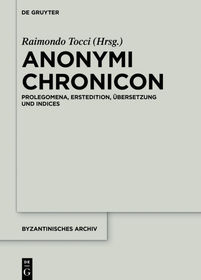
Anonymi Chronicon
Prolegomena, Erstedition, Übersetzung und Indices
Sorozatcím: Byzantinisches Archiv; 33;
-
20% KEDVEZMÉNY?
- A kedvezmény csak az 'Értesítés a kedvenc témákról' hírlevelünk címzettjeinek rendeléseire érvényes.
- Kiadói listaár EUR 124.95
-
48 805 Ft (46 481 Ft + 5% áfa)
Az ár azért becsült, mert a rendelés pillanatában nem lehet pontosan tudni, hogy a beérkezéskor milyen lesz a forint árfolyama az adott termék eredeti devizájához képest. Ha a forint romlana, kissé többet, ha javulna, kissé kevesebbet kell majd fizetnie.
- Kedvezmény(ek) 20% (cc. 9 761 Ft off)
- Kedvezményes ár 39 044 Ft (37 185 Ft + 5% áfa)
- A kedvezmény érvényes eddig: 2026. június 30.
Iratkozzon fel most és részesüljön kedvezőbb árainkból!
Feliratkozom
48 805 Ft

Beszerezhetőség
Még nem jelent meg, de rendelhető. A megjelenéstől számított néhány héten belül megérkezik.
Why don't you give exact delivery time?
A beszerzés időigényét az eddigi tapasztalatokra alapozva adjuk meg. Azért becsült, mert a terméket külföldről hozzuk be, így a kiadó kiszolgálásának pillanatnyi gyorsaságától is függ. A megadottnál gyorsabb és lassabb szállítás is elképzelhető, de mindent megteszünk, hogy Ön a lehető leghamarabb jusson hozzá a termékhez.
A termék adatai:
- Kiadás sorszáma 1
- Kiadó De Gruyter
- Megjelenés dátuma 2026. június 22.
- ISBN 9783110540628
- Kötéstípus Keménykötés
- Terjedelem230 oldal
- Méret 240x170 mm
- Súly 528 g
- Nyelv német 700
Kategóriák
Rövid leírás:
Das Byzantinische Archiv ist die Begleitreihe der Byzantinischen Zeitschrift und umfasst sowohl Monographien als auch Sammelbände. Es bietet ein Forum für Editionen, Kommentare sowie vertiefende Studien zu Einzelaspekten aus dem Bereich der Byzantinistik. Literatur, Geschichte und Kunstgeschichte einschließlich der damit verbundenen Neben- und Randdisziplinen sind gleichermaßen vertreten.
TöbbHosszú leírás:
Gemeinsam mit den Historien gehören die byzantinischen Chroniken der Königsdisziplin der byzantinischen Literatur, der Historiographie, an. Zugleich stellen sie zweifelsfrei ein wichtiges Vehikel der byzantinischen Weltanschauung dar, während ihre literarische Neubewertung immer häufiger im Mittelpunkt der wissenschaftlichen Auseinandersetzung steht. Der vorliegende Band bietet die editio princeps einer anonymen Kurzchronik des 10. Jh., die von Adam bis in das Jahr 976 reicht. Der Text fußt in erster Linie auf der interpolierten Version der Chronik des Georgios Monachos, die dem Kreis der Logothetenchronik angehört, und ist heute in zwei Handschriften des 15. Jh. überliefert, im Vaticanus Pal. gr. 369 und im Vindobonensis phil. gr. 333 (letztere, die als einzige den Anfang der Chronik enthält, konnte im Rahmen dieser Untersuchung ermittelt werden). Die Edition, begleitet von einer deutschen Übersetzung und umrahmt von Prolegomena und Indices, soll als Grundlage für die Annäherung an die literaturhistorische Bedeutung sowie die ideologische und didaktische Funktion dieses Subgenres der byzantinischen Chronik dienen, das bisher unzureichend erforscht ist, weil die Mehrzahl der Texte weiterhin unediert bleibt.
Byzantine chronicles constitute together with histories the supreme discipline of Byzantine literature, i. e. historiography. They are undoubtedly an important vehicle of Byzantine ideology and the reassessment of their literariness is increasingly attracting attention by scholars working in the area of Byzantine historical writing. The present volume offers the editio princeps of a 10th-century anonymous short chronicle (Kurzchronik) which covers the period from Adam up to 976. The text draws mainly from the interpolated version of George the Monk’s chronicle – which belongs to the circle of the Logothetes’ chronicle –, and is preserved in two 15th-century manuscripts, Vat. Pal. gr. 369 and Vind. phil. gr. 333 (the latter, the only one to transmit the beginning of the chronicle, is newly discovered). The critical edition, complete with Prolegomena and Indexes, is accompanied by a German translation. Since most texts belonging to this subgenre of the Byzantine chronicle are still unpublished, this edition lays the groundwork for determining its position within the history of Byzantine literature, as well as its ideological and didactic function.
Több
