

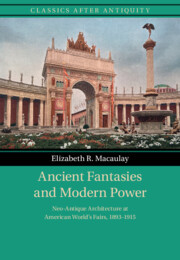
Ancient Fantasies and Modern Power
Neo-Antique Architecture at American World's Fairs, 1893-1915
Sorozatcím: Classics after Antiquity;
-
20% KEDVEZMÉNY?
- A kedvezmény csak az 'Értesítés a kedvenc témákról' hírlevelünk címzettjeinek rendeléseire érvényes.
- Kiadói listaár GBP 38.00
-
17 157 Ft (16 340 Ft + 5% áfa)
Az ár azért becsült, mert a rendelés pillanatában nem lehet pontosan tudni, hogy a beérkezéskor milyen lesz a forint árfolyama az adott termék eredeti devizájához képest. Ha a forint romlana, kissé többet, ha javulna, kissé kevesebbet kell majd fizetnie.
- Kedvezmény(ek) 20% (cc. 3 431 Ft off)
- Kedvezményes ár 13 726 Ft (13 072 Ft + 5% áfa)
- A kedvezmény érvényes eddig: 2026. június 30.
Iratkozzon fel most és részesüljön kedvezőbb árainkból!
Feliratkozom
17 157 Ft

Beszerezhetőség
Becsült beszerzési idő: A Prosperónál jelenleg nincsen raktáron, de a kiadónál igen. Beszerzés kb. 3-5 hét..
A Prosperónál jelenleg nincsen raktáron.
Why don't you give exact delivery time?
A beszerzés időigényét az eddigi tapasztalatokra alapozva adjuk meg. Azért becsült, mert a terméket külföldről hozzuk be, így a kiadó kiszolgálásának pillanatnyi gyorsaságától is függ. A megadottnál gyorsabb és lassabb szállítás is elképzelhető, de mindent megteszünk, hogy Ön a lehető leghamarabb jusson hozzá a termékhez.
A termék adatai:
- Kiadó Cambridge University Press
- Megjelenés dátuma 2026. március 19.
- ISBN 9781009407106
- Kötéstípus Puhakötés
- Terjedelem406 oldal
- Méret 245x172x17 mm
- Súly 790 g
- Nyelv angol
- Illusztrációk 75 colour illus. 688
Kategóriák
Rövid leírás:
The fantastical ancient Greco-Roman and Egyptian architecture of American world's fairs embodied the United States' modernity and progress.
TöbbHosszú leírás:
Chicago's Columbian Exposition of 1893 celebrated the quadricentennial of Columbus's 'discovery" of the Americas by creating a fantastical white city composed of Roman triumphal arches and domes, Corinthian colonnades, and Egyptian obelisks. World's fairs were among the most important cultural, socio-economic, and political phenomena of the nineteenth and twentieth centuries: millions visited hoping to understand the modernity and progress of these cities and the nascent superpower of the United States. But what they found was often a representation of the past. From 1893 to 1915, ancient Greco-Roman and Egyptian architecture was deployed to create immersive environments at Chicago, Nashville, Omaha, St. Louis, and San Francisco. The seemingly endless adaptations of ancient architecture at these five fairs demonstrated that ancient architecture can symbolize and transmit the complex-and often paradoxical or contradictory-ideas that defined the United States at the turn of the twentieth century and still endure today.
TöbbTartalomjegyzék:
Introduction; 1. The World's Columbian Exposition of 1893: A Phantasmagoric Dream of Antiquity; 2. The Athens of the South: The Parthenon, a Pyramid, and Neo-Antique Architecture at the Tennessee Centennial Exposition of 1897; 3. The Wild West Meets Greece and Rome: Neo-Antique Architecture at the Trans-Mississippi and International Exposition of 1898; 4. When Is Classical No Longer Classical?: The Grandeur of 'Free Renaissance' Architecture at the Louisiana Purchase Exposition of 1904; 5. The Thirteenth Labor of Hercules: Constructing Roman Ruins, Arches, Columns, and Baths at the 1915 Panama-Pacific International Exposition in San Francisco; Conclusions; Bibliography. Index.
Több
