

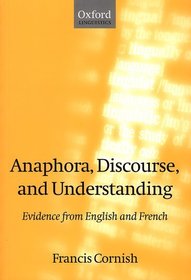
Anaphora, Discourse, and Understanding
Evidence from English and French
-
10% KEDVEZMÉNY?
- A kedvezmény csak az 'Értesítés a kedvenc témákról' hírlevelünk címzettjeinek rendeléseire érvényes.
- Kiadói listaár GBP 132.50
-
59 823 Ft (56 975 Ft + 5% áfa)
Az ár azért becsült, mert a rendelés pillanatában nem lehet pontosan tudni, hogy a beérkezéskor milyen lesz a forint árfolyama az adott termék eredeti devizájához képest. Ha a forint romlana, kissé többet, ha javulna, kissé kevesebbet kell majd fizetnie.
- Kedvezmény(ek) 10% (cc. 5 982 Ft off)
- Kedvezményes ár 53 841 Ft (51 278 Ft + 5% áfa)
Iratkozzon fel most és részesüljön kedvezőbb árainkból!
Feliratkozom
59 823 Ft

Beszerezhetőség
Megrendelésre a kiadó utánnyomja a könyvet. Rendelhető, de a szokásosnál kicsit lassabban érkezik meg.
Why don't you give exact delivery time?
A beszerzés időigényét az eddigi tapasztalatokra alapozva adjuk meg. Azért becsült, mert a terméket külföldről hozzuk be, így a kiadó kiszolgálásának pillanatnyi gyorsaságától is függ. A megadottnál gyorsabb és lassabb szállítás is elképzelhető, de mindent megteszünk, hogy Ön a lehető leghamarabb jusson hozzá a termékhez.
A termék adatai:
- Kiadó Clarendon Press
- Megjelenés dátuma 1999. április 15.
- ISBN 9780198236481
- Kötéstípus Keménykötés
- Terjedelem296 oldal
- Méret 242x161x22 mm
- Súly 565 g
- Nyelv angol
- Illusztrációk line diagrams 0
Kategóriák
Rövid leírás:
Anaphora and deixis are a major research focus in general linguistic theory. Understanding how they operate in communicative contexts is a central target in computational and cognitive linguistics. In this wide-ranging work with appeal for students, academics, and professionals in a variety of fields, Francis Cornish sets out an original theory of anaphora and deixis, and proposes a way of integrating the potential in-context interpretations of given anaphors within an existing model of discourse representation.
TöbbHosszú leírás:
"This was a different man," said Mr Welbecker. "Listen! This man was called Hamlet and his uncle had killed his father because he wanted to marry his mother."
"What did he want to marry his mother for?" said William. "I've never heard of anyone wanting to marry their mother."*
In almost any conversation the meaning of what is said depends on the listener seeing how some words refer to what has already been said, and that others must be related to the characteristics of time, place, or person of the situation around which the conversation revolves. These modes of reference, anaphora and deixis respectively, involve surprisingly complicated cognitive and syntactic processes, which people (normally) perform easily and unerringly. But they present formidable problems for the linguist and cognitive scientist trying to explain precisely how comprehension is achieved. Anaphora and deixis are thus a central research focus in syntactic theory, while understanding and modelling their operation in discourse are important targets in computational linguistics and cognitive science. In this ambitious work, Francis Cornish sets out an original theory of anaphora and deixis, and proposes a new and elegant theoretical model to represent the transfer of meaning in discourse.
Dr Cornish considers anaphoric reference in discourse from both psychological and linguistic perspectives. He argues that anaphora and deixis are essentially parts of integrative discourse procedures that facilitate the linking of representations held in working memory. He brings together work by linguists, formal semanticists, psychologists, and researchers in artificial intelligence, as well as drawing on his own extensive experimental work on a variety of corpora of different genres in French and English.
Anaphora, Discourse, and Understanding will interest researchers and advanced students in a variety of fields within and outside linguistics, including cognitive science, artificial intelligence, syntactic theory, formal semantics, and the analysis of discourse.
[* from William - The Pirate by Richmal Crompton, London, Macmillan, 1932]
this substantial book makes a most significant contribution to the treatment of anaphora from the perspectives of discourse studies, semantics and cognitive science, and will be an important source for researchers concerned with discourse and reference.
Tartalomjegyzék:
Introduction
Anaphora and discourse
Semantic-pragmatic determinants of anaphoric value: the role of the indexical segment
Exophora, saliency, and discourse memory
Reference within a discourse model: the mental representation of 'antecedents' and discourse referents
The user's perspective: the on-line processing of discourse anaphors
Conclusion

