

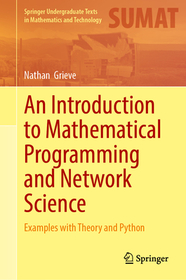
An Introduction to Mathematical Programming and Network Science
Examples with Theory and Python
Sorozatcím: Springer Undergraduate Texts in Mathematics and Technology;
-
20% KEDVEZMÉNY?
- A kedvezmény csak az 'Értesítés a kedvenc témákról' hírlevelünk címzettjeinek rendeléseire érvényes.
- Kiadói listaár EUR 64.19
-
25 072 Ft (23 878 Ft + 5% áfa)
Az ár azért becsült, mert a rendelés pillanatában nem lehet pontosan tudni, hogy a beérkezéskor milyen lesz a forint árfolyama az adott termék eredeti devizájához képest. Ha a forint romlana, kissé többet, ha javulna, kissé kevesebbet kell majd fizetnie.
- Kedvezmény(ek) 20% (cc. 5 014 Ft off)
- Kedvezményes ár 20 058 Ft (19 102 Ft + 5% áfa)
- A kedvezmény érvényes eddig: 2026. június 30.
Iratkozzon fel most és részesüljön kedvezőbb árainkból!
Feliratkozom
22 063 Ft

Beszerezhetőség
Még nem jelent meg, de rendelhető. A megjelenéstől számított néhány héten belül megérkezik.
Why don't you give exact delivery time?
A beszerzés időigényét az eddigi tapasztalatokra alapozva adjuk meg. Azért becsült, mert a terméket külföldről hozzuk be, így a kiadó kiszolgálásának pillanatnyi gyorsaságától is függ. A megadottnál gyorsabb és lassabb szállítás is elképzelhető, de mindent megteszünk, hogy Ön a lehető leghamarabb jusson hozzá a termékhez.
A termék adatai:
- Kiadó Springer Nature Switzerland
- Megjelenés dátuma 2026. május 15.
- ISBN 9783032133298
- Kötéstípus Keménykötés
- Terjedelem322 oldal
- Méret 235x155 mm
- Nyelv angol
- Illusztrációk XIX, 322 p. 53 illus., 30 illus. in color. 700
Kategóriák
Hosszú leírás:
"
This text provides a practical, hands-on introduction to the fundamental concepts of mathematical programming and network science. Particular emphasis is placed on linear programming, mathematical modelling and case studies, the implementation of the Simplex Method in Python, and classical techniques from nonlinear convex programming. The text also features a discussion of mathematical programming within the context of algebraic modelling languages. Further, it includes material on matrix games, decision analysis, multicriteria optimization and non-directed networks.
Designed as an introductory resource for upper-level undergraduate and graduate students, the book assumes only a modest mathematical background. Readers who have completed a second course in linear algebra, multivariable calculus, and an introductory course in probability and statistics will find the more advanced portions of the text especially accessible. Researchers and professionals in mathematics, engineering, technology, economics, business, and other quantitatively oriented fields will also find this book a valuable reference.
A distinguishing feature of this text is its strong emphasis on case studies. Numerous examples are developed in detail, either worked out within the text or explored through exercises and abstract model formulations. This pedagogical approach fosters both intuition and a structured understanding of the representative models that form the foundation of the field. A rich collection of end-of-chapter exercises enables readers to apply concepts and deepen their mastery of the material. A chapter dependency chart further supports independent learners by suggesting an effective study sequence and assists instructors in organizing coherent course structures.
" TöbbTartalomjegyzék:
1 Introduction.- 2 Linear programming models—a collection of case study examples.- 3 Towards a theory for mathematical programming problems.- 4 Introduction to Tucker Tableau and duality theory for linear programming.- 5 Simplex Algorithm via Tucker Tableau.- 6 Using computer software to solve linear programming problems.- 7 Transportation and assignment problems.- 8 Network Flow problems.- 9. Selected introduction to nonlinear programming.- 10 More general convex functions, Lagrangians and KKT conditions.- 11 Using computer software to solve selected nonlinear programming.- 12 Introduction to game theory, decision analysis and multicriteria optimization.- 13 Introduction to non-directed networks.- Appendix A Solving systems of linear equations.- Appendix B Convexity and optimization of smooth functions in dimensions one and two.- Appendix C Solution sketches to selected problems.- References.- Index.
Több
