

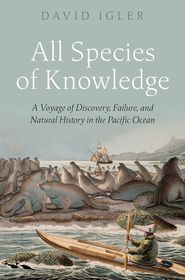
All Species of Knowledge
A Voyage of Discovery, Failure, and Natural History in the Pacific Ocean
-
10% KEDVEZMÉNY?
- A kedvezmény csak az 'Értesítés a kedvenc témákról' hírlevelünk címzettjeinek rendeléseire érvényes.
- Kiadói listaár GBP 22.99
-
10 379 Ft (9 885 Ft + 5% áfa)
Az ár azért becsült, mert a rendelés pillanatában nem lehet pontosan tudni, hogy a beérkezéskor milyen lesz a forint árfolyama az adott termék eredeti devizájához képest. Ha a forint romlana, kissé többet, ha javulna, kissé kevesebbet kell majd fizetnie.
- Kedvezmény(ek) 10% (cc. 1 038 Ft off)
- Kedvezményes ár 9 341 Ft (8 897 Ft + 5% áfa)
Iratkozzon fel most és részesüljön kedvezőbb árainkból!
Feliratkozom
10 379 Ft

Beszerezhetőség
Még nem jelent meg, de rendelhető. A megjelenéstől számított néhány héten belül megérkezik.
Why don't you give exact delivery time?
A beszerzés időigényét az eddigi tapasztalatokra alapozva adjuk meg. Azért becsült, mert a terméket külföldről hozzuk be, így a kiadó kiszolgálásának pillanatnyi gyorsaságától is függ. A megadottnál gyorsabb és lassabb szállítás is elképzelhető, de mindent megteszünk, hogy Ön a lehető leghamarabb jusson hozzá a termékhez.
A termék adatai:
- Kiadó OUP USA
- Megjelenés dátuma 2026. május 25.
- ISBN 9780197777688
- Kötéstípus Keménykötés
- Terjedelem272 oldal
- Méret 240x166x21 mm
- Súly 612 g
- Nyelv angol
- Illusztrációk 43 color illustrations 700
Kategóriák
Rövid leírás:
An engaging history of a three year voyage that set off to find the Northwest Passage but instead returned to Europe with extraordinary findings about species, Indigenous-produced knowledge of the Pacific world, and the people and nature of the Pacific, All Species of Knowledge reveals the shipboard production of knowledge in the early nineteenth century and the way it circulated throughout Europe.
TöbbHosszú leírás:
In 1815, the Russian vessel Rurik set off on a three-year voyage through the Pacific and Arctic oceans in a quest to find the world's most elusive geographic feature, the Northwest Passage. Financed by a wealthy Russian count and commanded by a fame-seeking captain, the vessel carried four extraordinary observers of the natural world, including an Indigenous navigator from the Caroline Islands named Kadu.
The Rurik failed in its mission, yet, as award-winning Pacific historian David Igler masterfully demonstrates, the crew's pursuit of "natural history" throughout the voyage and during its decades-long afterlife embodied a search for knowledge through science, artistic representation, and oral tradition. Failure to achieve a great discovery was common in the great age of scientific voyaging, but explorers, natural philosophers, and traveling artists grew adept at turning their explorations into documented achievements by claiming, publishing, and promoting a range of significant findings. No expedition did this more successfully than the crew of the Rurik. Much of their produced knowledge derived directly from the Indigenous communities they encountered in the Pacific. The men aboard the ship conveyed their discoveries through various mediums. Artist Ludwig Choris documented the experience in the first lithographic compendium of a Pacific expedition. Navigator Kadu informed his Marshall Islander elders and peers of the wonders and dangers he encountered. Naturalists Adelbert von Chamisso and Johann Eschscholtz produced an astonishing range of scientific studies for both scholarly and public audiences. Meanwhile, Captain Otto von Kotzebue defended his failure to locate the Northern Passage by claiming other geographic findings.
Featuring rare color images created during the voyage, All Species of Knowledge reveals the intimate and daily practice of shipboard natural history, the role expeditions played in enlightening societies around the world, and the multiple meanings of failure and discovery in the pursuit of knowledge.
Tartalomjegyzék:
Introduction: Grand Ambitions for a Motley Crew
Claiming Discoveries from St. Petersburg to the Bering Sea
Kadu's Voyage and a Second Attempt at the Northern Passage
Depicting Sites of Colonialism
Studying Species and Indigenous Knowledge
The Afterlife of a Voyage: Networks and Claiming Discoveries
Conclusion: Failures, Discoveries, and Legacies in Natural History

