

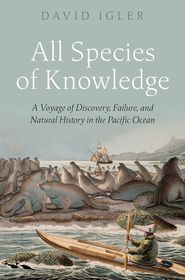
All Species of Knowledge
A Voyage of Discovery, Failure, and Natural History in the Pacific Ocean
- Publisher's listprice GBP 22.99
-
10 379 Ft (9 885 Ft + 5% VAT)
The price is estimated because at the time of ordering we do not know what conversion rates will apply to HUF / product currency when the book arrives. In case HUF is weaker, the price increases slightly, in case HUF is stronger, the price goes lower slightly.
- Discount 10% (cc. 1 038 Ft off)
- Discounted price 9 341 Ft (8 897 Ft + 5% VAT)
Subcribe now and take benefit of a favourable price.
Subscribe
10 379 Ft

Availability
Not yet published.
Why don't you give exact delivery time?
Delivery time is estimated on our previous experiences. We give estimations only, because we order from outside Hungary, and the delivery time mainly depends on how quickly the publisher supplies the book. Faster or slower deliveries both happen, but we do our best to supply as quickly as possible.
Product details:
- Publisher OUP USA
- Date of Publication 25 May 2026
- ISBN 9780197777688
- Binding Hardback
- No. of pages272 pages
- Size 240x166x21 mm
- Weight 612 g
- Language English
- Illustrations 43 color illustrations 700
Categories
Short description:
An engaging history of a three year voyage that set off to find the Northwest Passage but instead returned to Europe with extraordinary findings about species, Indigenous-produced knowledge of the Pacific world, and the people and nature of the Pacific, All Species of Knowledge reveals the shipboard production of knowledge in the early nineteenth century and the way it circulated throughout Europe.
MoreLong description:
In 1815, the Russian vessel Rurik set off on a three-year voyage through the Pacific and Arctic oceans in a quest to find the world's most elusive geographic feature, the Northwest Passage. Financed by a wealthy Russian count and commanded by a fame-seeking captain, the vessel carried four extraordinary observers of the natural world, including an Indigenous navigator from the Caroline Islands named Kadu.
The Rurik failed in its mission, yet, as award-winning Pacific historian David Igler masterfully demonstrates, the crew's pursuit of "natural history" throughout the voyage and during its decades-long afterlife embodied a search for knowledge through science, artistic representation, and oral tradition. Failure to achieve a great discovery was common in the great age of scientific voyaging, but explorers, natural philosophers, and traveling artists grew adept at turning their explorations into documented achievements by claiming, publishing, and promoting a range of significant findings. No expedition did this more successfully than the crew of the Rurik. Much of their produced knowledge derived directly from the Indigenous communities they encountered in the Pacific. The men aboard the ship conveyed their discoveries through various mediums. Artist Ludwig Choris documented the experience in the first lithographic compendium of a Pacific expedition. Navigator Kadu informed his Marshall Islander elders and peers of the wonders and dangers he encountered. Naturalists Adelbert von Chamisso and Johann Eschscholtz produced an astonishing range of scientific studies for both scholarly and public audiences. Meanwhile, Captain Otto von Kotzebue defended his failure to locate the Northern Passage by claiming other geographic findings.
Featuring rare color images created during the voyage, All Species of Knowledge reveals the intimate and daily practice of shipboard natural history, the role expeditions played in enlightening societies around the world, and the multiple meanings of failure and discovery in the pursuit of knowledge.
Table of Contents:
Introduction: Grand Ambitions for a Motley Crew
Claiming Discoveries from St. Petersburg to the Bering Sea
Kadu's Voyage and a Second Attempt at the Northern Passage
Depicting Sites of Colonialism
Studying Species and Indigenous Knowledge
The Afterlife of a Voyage: Networks and Claiming Discoveries
Conclusion: Failures, Discoveries, and Legacies in Natural History

