

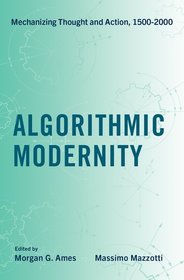
Algorithmic Modernity
Mechanizing Thought and Action, 1500-2000
-
10% KEDVEZMÉNY?
- A kedvezmény csak az 'Értesítés a kedvenc témákról' hírlevelünk címzettjeinek rendeléseire érvényes.
- Kiadói listaár GBP 61.00
-
29 142 Ft (27 755 Ft + 5% áfa)
Az ár azért becsült, mert a rendelés pillanatában nem lehet pontosan tudni, hogy a beérkezéskor milyen lesz a forint árfolyama az adott termék eredeti devizájához képest. Ha a forint romlana, kissé többet, ha javulna, kissé kevesebbet kell majd fizetnie.
- Kedvezmény(ek) 10% (cc. 2 914 Ft off)
- Kedvezményes ár 26 228 Ft (24 980 Ft + 5% áfa)
Iratkozzon fel most és részesüljön kedvezőbb árainkból!
Feliratkozom
29 142 Ft

Beszerezhetőség
Csak rendelésre kapható a kiadónál, kissé időigényes.
Why don't you give exact delivery time?
A beszerzés időigényét az eddigi tapasztalatokra alapozva adjuk meg. Azért becsült, mert a terméket külföldről hozzuk be, így a kiadó kiszolgálásának pillanatnyi gyorsaságától is függ. A megadottnál gyorsabb és lassabb szállítás is elképzelhető, de mindent megteszünk, hogy Ön a lehető leghamarabb jusson hozzá a termékhez.
A termék adatai:
- Kiadó OUP USA
- Megjelenés dátuma 2023. április 12.
- ISBN 9780197502426
- Kötéstípus Keménykötés
- Terjedelem312 oldal
- Méret 162x237x25 mm
- Súly 581 g
- Nyelv angol 453
Kategóriák
Rövid leírás:
Algorithmic Modernity brings together experts in the history of mathematics to create an informed history for readers interested in the social and cultural implications of today's pervasive digital algorithm.
TöbbHosszú leírás:
Algorithms have been transforming human society long before the advent of computing. Yet they continue to exist in relative invisibility despite their presence behind many of our modern social interactions. The rhetoric of algorithmic neutrality is more alive than ever, and algorithms are often depicted as obvious and unproblematic?without context and without history.
Algorithmic Modernity draws together the history of mathematics and intellectual history to convey the enduring global history of the algorithm as a computational tool, epistemic ideal, and rhetorical figure alongside the ascendance of modernity. Through historical reconstructions of relevant thinkers and cultural phenomena over the last five hundred years, this collection of essays reveals how algorithms became the standard method for solving problems from the early inclusion of algorithms in Newton's formation of calculus to their later influence in the New Deal economy. Together, these essays create an informed history for readers interested in the social and cultural implications of today's pervasive digital algorithm.
Featuring experts in mathematics, history, and computing, Algorithmic Modernity presents a multi-faceted exploration of the genealogy of algorithmic thinking in modern times.
Algorithms are both centuries old and central to today's hopes and fears. In this compelling book, ten first-rate historians of science and mathematics trace the genealogy of algorithmic practices and ideas that play a crucial role in the modern world.
Tartalomjegyzék:
Introduction
Morgan G. Ames and Massimo Mazzotti
Chapter 1: Algorithm and Demonstration in the Sixteenth-Century Ars Magna
Abram Kaplan
Chapter 2: "Some call it Arsmetrike, and some Awgryme": Misprision and Precision in Algorithmic Thinking and Learning in 1543 and Beyond
Michael J. Barany
Chapter 3: The Orderly Universe: How the Calculus Became an Algorithm
Amir Alexander
Chapter 4: The Algorithmic Enlightenment
J.B. Shank
Chapter 5: Capitalism by Algorithm: Numbers for the Innumerate in the 18th and 19th Century Atlantic World
Caitlin C. Rosenthal
Chapter 6: Material Mathematics: British Algebra as Algorithmic Mathematics
Kevin Lambert
Chapter 7: "For Computing is Our Duty": Algorithmic Workers, Servants, and Women at the Harvard Observatory
Andrew Fiss
Chapter 8: Seeds of Control: Sugar Beets, Control Algorithms, and New Deal Data Politics
Theodora Dryer
Chapter 9: Inference Rituals: Algorithms and the History of Statistics
Christopher J. Phillips
Chapter 10: Decision Trees, Random Forests, and the Genealogy of the Black Box
Matthew L. Jones
Index

