

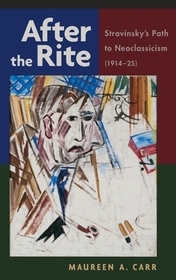
After the Rite
Stravinsky's Path to Neoclassicism (1914-1925)
-
10% KEDVEZMÉNY?
- A kedvezmény csak az 'Értesítés a kedvenc témákról' hírlevelünk címzettjeinek rendeléseire érvényes.
- Kiadói listaár GBP 67.00
-
32 009 Ft (30 485 Ft + 5% áfa)
Az ár azért becsült, mert a rendelés pillanatában nem lehet pontosan tudni, hogy a beérkezéskor milyen lesz a forint árfolyama az adott termék eredeti devizájához képest. Ha a forint romlana, kissé többet, ha javulna, kissé kevesebbet kell majd fizetnie.
- Kedvezmény(ek) 10% (cc. 3 201 Ft off)
- Kedvezményes ár 28 808 Ft (27 437 Ft + 5% áfa)
Iratkozzon fel most és részesüljön kedvezőbb árainkból!
Feliratkozom
32 009 Ft

Beszerezhetőség
Megrendelésre a kiadó utánnyomja a könyvet. Rendelhető, de a szokásosnál kicsit lassabban érkezik meg.
Why don't you give exact delivery time?
A beszerzés időigényét az eddigi tapasztalatokra alapozva adjuk meg. Azért becsült, mert a terméket külföldről hozzuk be, így a kiadó kiszolgálásának pillanatnyi gyorsaságától is függ. A megadottnál gyorsabb és lassabb szállítás is elképzelhető, de mindent megteszünk, hogy Ön a lehető leghamarabb jusson hozzá a termékhez.
A termék adatai:
- Kiadó OUP USA
- Megjelenés dátuma 2014. július 24.
- ISBN 9780199742936
- Kötéstípus Keménykötés
- Terjedelem356 oldal
- Méret 163x239x27 mm
- Súly 655 g
- Nyelv angol
- Illusztrációk 60 line art, 33 halftones, one 8 page color insert 0
Kategóriák
Rövid leírás:
After the Rite: Stravinsky's Path to Neoclassicism (1914-1925) traces the evolution of Stravinsky's compositional style as he searched for his own voice in the explosive musical world of the early 20th century as he responded to harsh criticisms of his work.
TöbbHosszú leírás:
The riot that erupted during the 1913 debut of Igor Stravinsky's The Rite of Spring at the Théâtre des Champs-Élysées in Paris has long been one of the most infamous and intriguing events of modern musical history. The third in a series of works commissioned for Sergei Diaghalev's famed Ballets Russes, the piece combined disjunct tonalities, provocative rhythms, and radical choreography that threw spectators and critics into a literal fury. In the century following its premiere, The Rite of Spring has demonstrated its earth-shattering impact on music and dance as well as its immortalizing effect on Stravinsky and his career. Having gained international attention by the age of 30, what direction could Stravinsky's path forward take after the momentus events of 1913?
After the Rite: Stravinsky's Path to Neoclassicism (1914-1925) traces the evolution of Stravinsky's compositional style as he searched for his own voice in the explosive musical world of the early 20th century as he responded to harsh criticisms of his work. Throughout the book, author Maureen Carr presents new transcriptions and sophisticated analyses of selected musical sketches to show the genesis of Stravinsky's musical ideas as he forayed into surrealism, classicism, and abstraction to develop his signature Neoclassical style. Exploring these annotated compositional experiments--such as the earliest evidence of Stravinsky's appropriation of the "rag idiom" and the development of his so-called "sound blocks"--After the Rite provides new insight into how Stravinsky challenged and guided the musical developments of the decade after that legendary Paris premiere. Enlightening visual metaphors, such as the contemporary paintings of Paul Klee and those of the Russian futurists, supplement discussion of the musical sketches throughout, offering a comprehensive artistic context for Carr's unprecedented and rigorous examination.
A treasure trove of outstanding material for scholars, musicians, students, and general readers alike, After the Rite offers a much-needed delineation of the concept of musical neoclassicism. Maureen Carr's innovative and detailed examination of the metamorphosis of Igor Stravinsky's compositional style after The Rite of Spring is an invaluable contribution to the literature concerning this iconic 20th century composer.
Carr's book contains a vast amount of information, including musical examples, sketch reproductions, tabular presentations of musical form, and meticulous documentation. Thus, it will prove invaluable to the student of this period in Stravinskys life.
Tartalomjegyzék:
Prologue
Chapter One:
The emergence of Stravinsky's neoclassicism and the aesthetic underpinnings of the idea in the other arts and in recent social/political history
Chapter Two:
Stravinsky at the Crossroads after the Rite
Jeu de rossignol mécanique [Performance of the Mechanical Nightingale] (1 August 1913)
Trois pièces (Vl 2, Va, Vc; ), II [Three Pieces for String Quartet, II]
Grotesques
"Eccentrique" (2 July 1914)
Trois pièces faciles (Kl 4 hdg) [Three Easy Pieces] (4 hands)
"Marche" (19 December 1914)
Chapter Three:
Stravinsky at the Crossroads between Primitivism and Neoclassicism
Renard [Bajka](1915-1916)
and
Histoire du soldat (1917-1918)
Chapter Four:
Stravinsky's Improvisatory Style
The predictive qualities of the Étude pour Pianola (1917)
Stravinsky's appropriation of the "rag idiom" (1917)
Stravinsky completes three works that were inspired by elements of ragtime (1918):
(1) Ragtime (for piano and the same piece arranged for 11 Instruments),
(2) "Ragtime" as one of the three dances in Histoire du soldat and
(3) the last movement of Trois pièces pour clarinette.
The two faces of Stravinsky's Piano-Rag-Music (1919): portrait or collage?
Chapter Five:
Stravinsky's Compositional Process for Symphonies d'instruments à vent (191?-1920) and Concertino (1920) as understood through the overlapping of the musical sketches and the resulting sound blocks
Chapter Six:
Les cinq doigts (1921) as a link between Pulcinella (1919-1920) and Mavra (1922)
Commentaries by Poulenc, Schloezer, Cocteau and Mayakovsky with Stravinsky at the Pleyel Factory (November 18, 1922); retrospective commentaries about Mavra in Poetics
Chapter Seven:
Stravinsky's Neoclassicism flourishes in Oktett (1919-1923)
Experiments with Cinq pieces monométriques (-; 192?)
Konzert (Piano and Winds) (1923-1924)
Chapter Eight:
Stravinsky's models from the piano literature (by Bach, Beethoven, Chopin)
NPR interview with Charles Rosen and Elliot Carter on Beethoven influences in the Sonata
commentaries by Arthur Lourié, Boris deShloezer, Roman Vlad
Sonate (Piano) (1924)
Sérénade en la (1925)
Epilogue

