

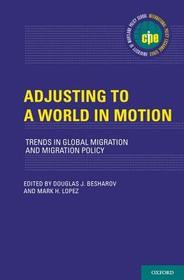
Adjusting to a World in Motion
Trends in Global Migration and Migration Policy
Sorozatcím: International Policy Exchange Series;
-
10% KEDVEZMÉNY?
- A kedvezmény csak az 'Értesítés a kedvenc témákról' hírlevelünk címzettjeinek rendeléseire érvényes.
- Kiadói listaár GBP 100.00
-
45 150 Ft (43 000 Ft + 5% áfa)
Az ár azért becsült, mert a rendelés pillanatában nem lehet pontosan tudni, hogy a beérkezéskor milyen lesz a forint árfolyama az adott termék eredeti devizájához képest. Ha a forint romlana, kissé többet, ha javulna, kissé kevesebbet kell majd fizetnie.
- Kedvezmény(ek) 10% (cc. 4 515 Ft off)
- Kedvezményes ár 40 635 Ft (38 700 Ft + 5% áfa)
Iratkozzon fel most és részesüljön kedvezőbb árainkból!
Feliratkozom
45 150 Ft

Beszerezhetőség
Megrendelésre a kiadó utánnyomja a könyvet. Rendelhető, de a szokásosnál kicsit lassabban érkezik meg.
Why don't you give exact delivery time?
A beszerzés időigényét az eddigi tapasztalatokra alapozva adjuk meg. Azért becsült, mert a terméket külföldről hozzuk be, így a kiadó kiszolgálásának pillanatnyi gyorsaságától is függ. A megadottnál gyorsabb és lassabb szállítás is elképzelhető, de mindent megteszünk, hogy Ön a lehető leghamarabb jusson hozzá a termékhez.
A termék adatai:
- Kiadó OUP USA
- Megjelenés dátuma 2016. február 11.
- ISBN 9780190211394
- Kötéstípus Keménykötés
- Terjedelem440 oldal
- Méret 168x234x38 mm
- Súly 703 g
- Nyelv angol 0
Kategóriák
Rövid leírás:
Today, 215 million people live outside their home countries and another 700 million say they would migrate to another country if they could. This volume examines the ways both sending and receiving nations are modifying their migration policies to control entry, to encourage assimilation, and to build links between diasporas and their home countries.
TöbbHosszú leírás:
International migration has reached new heights since the 1960s. Altogether, some 215 million people live in countries other than their countries of birth, and according to surveys, another 700 million say they would leave their homes and move to another country if they could. Nations-both sending and receiving-have responded to this growing international migrant flow with new laws and domestic programs. In receiving countries, they include laws and programs to control entry, encourage high-skilled immigration, develop refugee policy, and speed assimilation. In sending countries, governments are implementing and experimenting with new policies that link migrant diasporas back to their home countries culturally or economically-or both.
This volume contains a series of thoughtful analyses of some of the most critical issues raised in both receiving and sending countries, including US immigration policy, European high skilled labor programs, the experiences of migrants to the Gulf States, the impact of immigration on student educational achievement, and how post-conflict nations connect with their diasporas. We hope that the volume helps readers draw lessons for their own countries, and, hence, is offered in the spirit of mutual learning within a continued international dialogue of research and analysis on migration.
Tartalomjegyzék:
1. Introduction, Douglas J. Besharov and Mark H. Lopez
Part I: A World in Motion
2. Global Desires to Migrate, Neli Esipova, Rajesh Srinivasan, and Julie Ray
3. Patterns of Global Migration, Ellen L. Berg and Douglas J. Besharov
Part II. The Western Hemisphere
4. Immigrants in the United States: Many, Diverse and Growing, Eileen Patten
5. Declining Mexican Migration to the US, Andrew Selee
6. Educating the Children of Immigrants in the US, Dylan Conger and Rebecca Hinze-Pifer
7. Searching for New Policy Frameworks in the Wake of the Great Recession, Roberto Suro
Part III. Europe
8. The Evolution of EU Migration Policies: Towards a Balanced, Comprehensive and Common Approach? Anja Wiesbrock
9. EU Migration Policies and External Relations, Katharina Eisele
10. Citizenship Policies in the EU, Maarten Peter Vink and Gerard-René de Groot
11. Highly Skilled Migration to the EU and the US, Metka Hercog and Anja Wiesbrock
12. Educational Performance of the Children of Immigrants in Sixteen OECD Countries, Jaap Dronkers and Manon de Heus
Part IV. The Middle East and Asia
13. Middle East Country Migration Policies, Binod Khadria
14. Population Imbalance as a Public Policy Problem in United Arab Emirates, Ahmed Mustafa Elhussein Mansour
15. Indian Migration and "Temporary " Labor Programs in the US, UK, and Netherlands, Mary E. Breeding
Part V: Diaspora Engagement Strategies
16. Diaspora Engagement Policies and the Power of the Strong State: India and Ethiopia, Katie Kuschminder and Metka Hercog (29 pages, 25 without references)
17. Diaspora Engagement Policies after Conflict: Burundi and Rwanda, Sonja Fransen and Melissa Siegel
18. Diaspora Engagement Policies of Countries with Similar Emigration Histories: Morocco and Turkey, Özge Bilgili and Silja Weyel

