

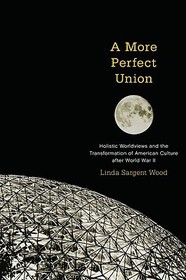
A More Perfect Union
Holistic Worldviews and the Transformation of American Culture after World War II
-
10% KEDVEZMÉNY?
- A kedvezmény csak az 'Értesítés a kedvenc témákról' hírlevelünk címzettjeinek rendeléseire érvényes.
- Kiadói listaár GBP 78.00
-
35 217 Ft (33 540 Ft + 5% áfa)
Az ár azért becsült, mert a rendelés pillanatában nem lehet pontosan tudni, hogy a beérkezéskor milyen lesz a forint árfolyama az adott termék eredeti devizájához képest. Ha a forint romlana, kissé többet, ha javulna, kissé kevesebbet kell majd fizetnie.
- Kedvezmény(ek) 10% (cc. 3 522 Ft off)
- Kedvezményes ár 31 695 Ft (30 186 Ft + 5% áfa)
Iratkozzon fel most és részesüljön kedvezőbb árainkból!
Feliratkozom
35 217 Ft

Beszerezhetőség
Megrendelésre a kiadó utánnyomja a könyvet. Rendelhető, de a szokásosnál kicsit lassabban érkezik meg.
Why don't you give exact delivery time?
A beszerzés időigényét az eddigi tapasztalatokra alapozva adjuk meg. Azért becsült, mert a terméket külföldről hozzuk be, így a kiadó kiszolgálásának pillanatnyi gyorsaságától is függ. A megadottnál gyorsabb és lassabb szállítás is elképzelhető, de mindent megteszünk, hogy Ön a lehető leghamarabb jusson hozzá a termékhez.
A termék adatai:
- Kiadó OUP USA
- Megjelenés dátuma 2010. szeptember 30.
- ISBN 9780195377743
- Kötéstípus Keménykötés
- Terjedelem352 oldal
- Méret 165x241x22 mm
- Súly 626 g
- Nyelv angol
- Illusztrációk 11 black and white halftones 0
Kategóriák
Rövid leírás:
This book uncovers a holistic sensibility in post-World War II American culture that challenged Cold War logic and fed some of the century's most powerful social movements. This impulse is illustrated by focusing on Rachel Carson; Buckminster Fuller; Martin Luther King, Jr.; Abraham Maslow; Pierre Teilhard de Chardin; and the Esalen Institute.
TöbbHosszú leírás:
In 1962, when the Cold War threatened to ignite in the Cuban Missile Crisis, when more nuclear test bombs were detonated than in any other year in history, Rachel Carson released her own bombshell, Silent Spring, to challenge society's use of pesticides. To counter the use of chemicals--and bombs--the naturalist articulated a holistic vision. She wrote about a "web of life" that connected humans to the world around them and argued that actions taken in one place had consequences elsewhere. Pesticides sprayed over croplands seep into ground water and move throughout the ecosystem, harming the environment. Thousands accepted her message, joined environmental groups, flocked to Earth Day celebrations, and lobbied for legislative regulation.
Carson was not the only intellectual to offer holistic answers to society's problems. This book uncovers a holistic sensibility in post-World War II American culture that both tested the logic of the Cold War and fed some of the twentieth century's most powerful social movements, from civil rights to environmentalism to the counterculture. The study examines six important leaders and institutions that embraced and put into practice a holistic vision for a peaceful, healthful, and just world: nature writer Rachel Carson; structural engineer R. Buckminster Fuller; civil rights leader Martin Luther King Jr.; Jesuit priest and paleontologist Pierre Teilhard de Chardin; humanistic psychologist Abraham Maslow; and the Esalen Institute and its founders, Michael Murphy and Dick Price. Each looked to whole systems instead of parts and focused on connections, interdependencies, and integration to create a better world.
In the 1960s and 1970s, holistic conceptions and practices infused the March on Washington, Earth Day, the human potential movement, New Age spirituality, and alternative medicine. Though dreams of creating a more perfect world were tempered by economic inequalities, political corruption, and deep social divisions, this sensibility influenced American culture in important ways that continue into the twenty-first century.
Linda Sargent Wood has produced a creative history of post-World War II American culture by centering it on the idea and manifestation of holism... She approaches the topic through five individuals and one institution, each the focus of a chapter of the book. The diversity of these subjects demonstrates well the wide extent of holism in various walks of American life at this time, while their interconnections suggest the multiple ways holism converged. A More Perfect Union prompts a consideration of wholes and parts, communities and individuals, the global and the local.
Tartalomjegyzék:
Preface
Introduction: Holistic Sensibilities in the Long 1960s
The Natural Environment: Rachel Carson's Web of Life
The Built Environment: Buckminster Fuller's Spaceship Earth
The Social World: Martin Luther King, Jr.'s Beloved Community
Cosmic Dimensions: Pierre Teilhard de Chardin's Omega Point
The Psychological Realm: Abraham Maslow's Self-Actualized
Individuals and Eupsychian Community
The Esalen Institute: A Center for Holistic Pursuits
Epilogue
Notes
Bibliography
Index

