

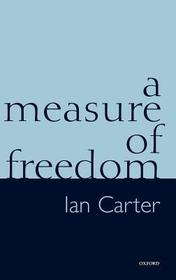
A Measure of Freedom
-
10% KEDVEZMÉNY?
- A kedvezmény csak az 'Értesítés a kedvenc témákról' hírlevelünk címzettjeinek rendeléseire érvényes.
- Kiadói listaár GBP 207.50
-
93 686 Ft (89 225 Ft + 5% áfa)
Az ár azért becsült, mert a rendelés pillanatában nem lehet pontosan tudni, hogy a beérkezéskor milyen lesz a forint árfolyama az adott termék eredeti devizájához képest. Ha a forint romlana, kissé többet, ha javulna, kissé kevesebbet kell majd fizetnie.
- Kedvezmény(ek) 10% (kb. 9 368 Ft)
- Kedvezményes ár 84 318 Ft (80 303 Ft + 5% áfa)
Iratkozzon fel most és részesüljön kedvezőbb árainkból!
Feliratkozom
93 686 Ft

Beszerezhetőség
Megrendelésre a kiadó utánnyomja a könyvet. Rendelhető, de a szokásosnál kicsit lassabban érkezik meg.
Why don't you give exact delivery time?
A beszerzés időigényét az eddigi tapasztalatokra alapozva adjuk meg. Azért becsült, mert a terméket külföldről hozzuk be, így a kiadó kiszolgálásának pillanatnyi gyorsaságától is függ. A megadottnál gyorsabb és lassabb szállítás is elképzelhető, de mindent megteszünk, hogy Ön a lehető leghamarabb jusson hozzá a termékhez.
A termék adatai:
- Kiadó OUP Oxford
- Megjelenés dátuma 1999. március 25.
- ISBN 9780198294535
- Kötéstípus Keménykötés
- Terjedelem322 oldal
- Méret 242x162x22 mm
- Súly 607 g
- Nyelv angol 0
Kategóriák
Rövid leírás:
How do we know when one person or society is `freer' than another? Can freedom be measured? Is more freedom better than less? This book provides the first full-length treatment of these fundamental yet neglected issues, throwing new light both on the notion of freedom and on contemporary liberalism.
TöbbHosszú leírás:
It is often said that one person or society is `freer' than another, or that people have a right to equal freedom, or that freedom should be increased or even maximized. Such quantitative claims about freedom are of great importance to us, forming an essential part of our political discourse and theorizing. Yet their meaning has been surprisingly neglected by political philosophers until now.
Ian Carter provides the first systematic account of the nature and importance of our judgements about degrees of freedom. He begins with an analysis of the normative assumptions behind the claim that individuals are entitled to a measure of freedom, and then goes on to ask whether it is indeed conceptually possible to measure freedom. Adopting a coherentist approach, the author argues for a conception of freedom that not only reflects commonly held intuitions about who is freer than who but is also compatible with a liberal or freedom-based theory of justice.
"Ian Carter's book on freedom is a first-rate work of political and legal philosophy. It is extraordinarily well structured, technically sophisticated, consistently illuminating, and rigorously argumentative. For those theorists (including the present reviewer) who disagree with a number of its positions, it is a volume that will amply repay critical reflection. Indeed, of the myriad books published in the twentieth century on the philosophy of freedom, Carter's is probably the best." Matthew H.Kramer, Cambridge Law Journal 2000
Tartalomjegyzék:
Introduction
PART I: JUSTICE AND OVERALL FREEDOM
The Concept of Overall Freedom
The Value of Freedom
The Distribution of Freedom
Reflective Equilibrium
PART II: VALUE-BASED FREEDOM
The Value-Based Approach
Self-Mastery
PART III: EMPIRICAL FREEDOM
Individual Freedom: Actions
Individual Freedom: Constraints
Group Freedom
Indicators of Freedom
Conclusion
Bibliography

