

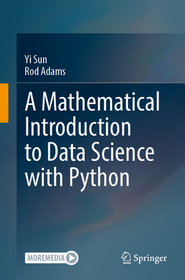
A Mathematical Introduction to Data Science with Python
-
20% KEDVEZMÉNY?
- A kedvezmény csak az 'Értesítés a kedvenc témákról' hírlevelünk címzettjeinek rendeléseire érvényes.
- Kiadói listaár EUR 64.19
-
25 072 Ft (23 878 Ft + 5% áfa)
Az ár azért becsült, mert a rendelés pillanatában nem lehet pontosan tudni, hogy a beérkezéskor milyen lesz a forint árfolyama az adott termék eredeti devizájához képest. Ha a forint romlana, kissé többet, ha javulna, kissé kevesebbet kell majd fizetnie.
- Kedvezmény(ek) 20% (cc. 5 014 Ft off)
- Kedvezményes ár 20 058 Ft (19 102 Ft + 5% áfa)
- A kedvezmény érvényes eddig: 2026. június 30.
Iratkozzon fel most és részesüljön kedvezőbb árainkból!
Feliratkozom
22 063 Ft

Beszerezhetőség
Még nem jelent meg, de rendelhető. A megjelenéstől számított néhány héten belül megérkezik.
Why don't you give exact delivery time?
A beszerzés időigényét az eddigi tapasztalatokra alapozva adjuk meg. Azért becsült, mert a terméket külföldről hozzuk be, így a kiadó kiszolgálásának pillanatnyi gyorsaságától is függ. A megadottnál gyorsabb és lassabb szállítás is elképzelhető, de mindent megteszünk, hogy Ön a lehető leghamarabb jusson hozzá a termékhez.
A termék adatai:
- Kiadó Springer Nature Singapore
- Megjelenés dátuma 2026. május 19.
- ISBN 9789819536672
- Kötéstípus Puhakötés
- Terjedelem399 oldal
- Méret 235x155 mm
- Nyelv angol
- Illusztrációk XVII, 399 p. 54 illus., 52 illus. in color. With online files/update. 700
Kategóriák
Hosszú leírás:
"
This textbook serves as a companion to ""A Mathematical Introduction to Data Science"". It uses Python programming to provide a comprehensive foundation in the mathematics needed for data science. It is designed for anyone with a basic mathematical background, including students and self-learners interested in understanding the principles behind the computational algorithms used in data science. The focus of this book is to demonstrate how programming can aid in this understanding and be used in solving mathematical problems. It is written using Python as its programming language, but readers do not need prior knowledge of Python to benefit from it.
Some examples from ""A Mathematical Introduction to Data Science"" are used to illustrate key concepts such as sets, functions, linear algebra, calculus, and probability and statistics, through Python programming, though it is not necessary to have seen the examples before. Further, this textbook shows how those mathematical concepts can be applied in widely used computational algorithms, such as Principal Component Analysis, Singular Value Decomposition, Linear Regression in two and more dimensions, Simple Neural Networks, Maximum Likelihood Estimation, Logistic Regression and Ridge Regression.
This textbook is designed with the assumption that readers have no prior knowledge of Python but possess a basic understanding of programming concepts, such as control flow. Ideally, readers should have both this book and its companion, ""A Mathematical Introduction to Data Science"". However, those with a strong mathematical background and an interest in programming implementations can benefit from reading this textbook alone.
" TöbbTartalomjegyzék:
Chapter 1 Introduction.- Chapter 2 Sets and Functions.- Chapter 3 Liner Algebra.- Chapter 4 Matrix Decomposition.- Chapter 5 Calculus.- Chapter 6 Advanced Calculus.- Chapter 7 Algorithms 1 – Principal Component Analysis.- Chapter 8 Algorithms 2 – Liner Regression.- Chapter 9 Algorithms 3 – Neural Networks.- Chapter 10 Probability.- Chapter 11 Further Probability.- Chapter 12 Elements of Statistics.- Chapter 13 Algorithms 4 – Maximum Likelihood Estimation and Its Application to Regression.- Chapter 14 Data Modelling in Practice.
Több
