

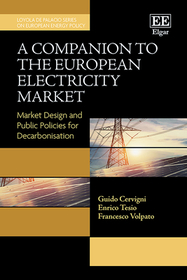
A Companion to the European Electricity Market – Market Design and Public Policies for Decarbonisation
Market Design and Public Policies for Decarbonisation
Sorozatcím: Loyola de Palacio Series on European Energy Policy;
-
10% KEDVEZMÉNY?
- A kedvezmény csak az 'Értesítés a kedvenc témákról' hírlevelünk címzettjeinek rendeléseire érvényes.
- Kiadói listaár GBP 156.00
-
70 434 Ft (67 080 Ft + 5% áfa)
Az ár azért becsült, mert a rendelés pillanatában nem lehet pontosan tudni, hogy a beérkezéskor milyen lesz a forint árfolyama az adott termék eredeti devizájához képest. Ha a forint romlana, kissé többet, ha javulna, kissé kevesebbet kell majd fizetnie.
- Kedvezmény(ek) 10% (cc. 0 Ft off)
- Kedvezményes ár 63 391 Ft (60 372 Ft + 5% áfa)
Iratkozzon fel most és részesüljön kedvezőbb árainkból!
Feliratkozom
70 434 Ft

Beszerezhetőség
Becsült beszerzési idő: A Prosperónál jelenleg nincsen raktáron, de a kiadónál igen. Beszerzés kb. 3-5 hét..
A Prosperónál jelenleg nincsen raktáron.
Why don't you give exact delivery time?
A beszerzés időigényét az eddigi tapasztalatokra alapozva adjuk meg. Azért becsült, mert a terméket külföldről hozzuk be, így a kiadó kiszolgálásának pillanatnyi gyorsaságától is függ. A megadottnál gyorsabb és lassabb szállítás is elképzelhető, de mindent megteszünk, hogy Ön a lehető leghamarabb jusson hozzá a termékhez.
A termék adatai:
- Kiadó Edward Elgar
- Megjelenés dátuma 2024. december 20.
- ISBN 9781802203660
- Kötéstípus Keménykötés
- Terjedelem316 oldal
- Méret 240x163x22 mm
- Súly 590 g
- Nyelv angol 547
Kategóriák
Rövid leírás:
This forward-thinking Companion provides a cutting-edge analysis into the design and implementation of the electricity market in Europe. It assesses the alternative arrangements that are being developed to achieve decarbonisation as well as the economic rationale behind those designs.
TöbbHosszú leírás:
This forward-thinking Companion provides a cutting-edge analysis into the design and implementation of the electricity market in Europe. It assesses the alternative arrangements that are being developed to achieve decarbonisation as well as the economic rationale behind those designs.
Outlining the social and political elements which make the European electricity market unique, the book highlights how current policy objectives will shape its design in the coming decades. It identifies how Europe's ambitious 2050 decarbonisation policies have placed the design of electricity markets at the forefront of political agendas. Contributing authors investigate the ability of the market to integrate new renewable electricity generation, adopting both economic and regulatory concepts to address strategic policy issues.
A Companion to the European Electricity Market is an essential read for graduate students and scholars of economics and energy regulation in governance, particularly those interested in the European electricity sector, those looking to improve their comprehension of the European electricity market, and those wanting to develop an understanding of the impact of climate decisions. Engineers, economists, and policy makers will find this to be a fundamental resource.
‘By thoroughly covering power market economics, this volume provides readers with the ability to understand and investigate the benefits and possibly the deficiencies of the 25-plus-year history of national and regional markets in the European Union. Readers may also be motivated to understand and contemplate the major interaction of clean/renewable generation on new demand (EV battery charging, HVAC preheating-cooling and other types of storage - like-load demands with intertemporal degrees of freedom) that may be amply capable in the near future to modulate a sizable portion of electricity consumption dynamically so as to follow and compensate for non-schedulable and volatile renewable generation.’

