

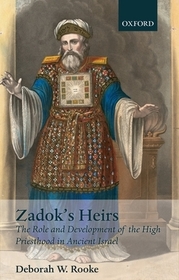
Zadok's Heirs
The Role and Development of the High Priesthood in Ancient Israel
Series: Oxford Theological Monographs;
- Publisher's listprice GBP 71.00
-
32 056 Ft (30 530 Ft + 5% VAT)
The price is estimated because at the time of ordering we do not know what conversion rates will apply to HUF / product currency when the book arrives. In case HUF is weaker, the price increases slightly, in case HUF is stronger, the price goes lower slightly.
- Discount 10% (cc. 3 206 Ft off)
- Discounted price 28 851 Ft (27 477 Ft + 5% VAT)
Subcribe now and take benefit of a favourable price.
Subscribe
32 056 Ft

Availability
printed on demand
Why don't you give exact delivery time?
Delivery time is estimated on our previous experiences. We give estimations only, because we order from outside Hungary, and the delivery time mainly depends on how quickly the publisher supplies the book. Faster or slower deliveries both happen, but we do our best to supply as quickly as possible.
Product details:
- Publisher OUP Oxford
- Date of Publication 30 August 2012
- ISBN 9780199661114
- Binding Paperback
- No. of pages404 pages
- Size 216x141x21 mm
- Weight 482 g
- Language English 0
Categories
Short description:
This unique study is the first systematic examination to be undertaken of the high priesthood in ancient Israel, from the earliest local chief priests in the pre-monarchic period down to the Hasmonaean priest-kings in the first century BCE.
MoreLong description:
This unique study is the first systematic examination to be undertaken of the high priesthood in ancient Israel, from the earliest local chief priests in the pre-monarchic period down to the Hasmonaean priest-kings in the first century BCE. Deborah Rooke argues that, contrary to received scholarly opinion, the high priesthood was fundamentally a religious office which in and of itself bestowed no civil responsibilities upon its holders, and that not until the time of the Maccabean revolt does the high priest appear as the sole figure of leadership for the nation. However, even the Maccabean / Hasmonaean high priesthood was effectively a reversion to the monarchic model of sacral kingship which had existed several centuries earlier in the pre-exilic period, rather than being an extension of the powers of the high priesthood itself. The idea that high priesthood per se bestowed the power to rule should therefore be reconsidered.
Deborah Rooke offers detailed and carefully ordered investigations of a wide range of primary source materials ... Her comprehension of this vast array of writings, her familiarity with the secondary literature about them and the erudition she so often displays make this a truly remarkable book, not least for the amount and quality of the information it has to offer ... This is a book which no student of the Jewish priesthood can afford to ignore.
Table of Contents:
Introduction
I: Towards an Understanding of High Priesthood
High Priesthood According to the Priestly Writer
II: High Priesthood to the End of Exile
High Priesthood in the Deuteronomistic History
Mysterious Melchizedek
Ezekiel: A Vision of Hierocracy?
Part II: Summary
III: High Priesthood in the Persian Period
High-Priestly Power in Haggai and Zechariah 1-8
Ezra and Nehemiah: The High Priesthood in Fifth-Century Judah
The Elephantine Papyri
High Priesthood in the Books of Chronicles
After the Canon: the Later Persian Period
Part III: Summary
IV: High Priesthood from Alexander to Pompey
The Hidden Years: High Priesthood under the Ptolemies
The Maccabean Conquest: Jonathan and Simon the Maccabees
The Hasmonean Dynasty: John Hyrcanus and his Successors
Part IV: Summary
Conclusion

