
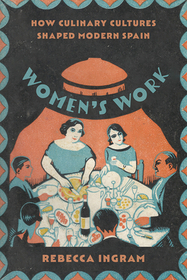
Women′s Work – How Culinary Cultures Shaped Modern Spain
How Culinary Cultures Shaped Modern Spain
- Publisher's listprice GBP 28.00
-
13 377 Ft (12 740 Ft + 5% VAT)
The price is estimated because at the time of ordering we do not know what conversion rates will apply to HUF / product currency when the book arrives. In case HUF is weaker, the price increases slightly, in case HUF is stronger, the price goes lower slightly.
- Discount 10% (cc. 1 338 Ft off)
- Discounted price 12 039 Ft (11 466 Ft + 5% VAT)
Subcribe now and take benefit of a favourable price.
Subscribe
13 377 Ft
Availability
Not yet published.
Why don't you give exact delivery time?
Delivery time is estimated on our previous experiences. We give estimations only, because we order from outside Hungary, and the delivery time mainly depends on how quickly the publisher supplies the book. Faster or slower deliveries both happen, but we do our best to supply as quickly as possible.
Product details:
- Publisher University of Chicago Press
- Date of Publication 25 March 2026
- ISBN 9780826504890
- Binding Paperback
- No. of pages220 pages
- Size 228x152 mm
- Language English 700
Categories
Short description:
Even with global attention, we know little about how Spanish cooking became a litmus test for demonstrating Spain&&&8217;s modernity and, in relation, the roles ascribed to the modern Spanish women responsible for daily cooking. This book places these efforts in their historical context.
MoreLong description:
We are living a moment in which famous chefs, Michelin stars, culinary techniques, and gastronomical accolades attract moneyed tourists to Spain from all over the world. This has prompted the Spanish government to declare its cuisine as part of Spanish patrimony.
Yet even with this widespread global attention, we know little about how Spanish cooking became a litmus test for demonstrating Spain&&&8217;s modernity and, in relation, the roles ascribed to the modern Spanish women responsible for daily cooking. Efforts to articulate a new, modern Spain infiltrated writing in multiple genres and media. Women&&&8217;s Work places these efforts in their historical context to yield a better understanding of the roles of food within an inherently uneven modernization process. Further, the book reveals the paradoxical messages women have navigated, even in texts about a daily practice that shaped their domestic and work lives. This argument is significant because of the degree to which domestic activities, including cooking, occupied women&&&8217;s daily lives, even while issues like their fitness as citizens and participation in the public sphere were hotly debated. At the same time, progressive intellectuals from diverse backgrounds began to invoke Spanish cooking and eating as one measure of Spanish modernity.
Women&&&8217;s Work shows how culinary writing engaged these debates and reached women at the site of much of their daily labor&&&8212;the kitchen&&&8212;and, in this way, shaped their thinking about their roles in modernizing Spain.