

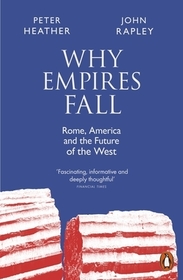
Why Empires Fall
Rome, America and the Future of the West
-
GET 20% OFF
- Publisher's listprice GBP 12.99
-
5 864 Ft (5 585 Ft + 5% VAT)
The price is estimated because at the time of ordering we do not know what conversion rates will apply to HUF / product currency when the book arrives. In case HUF is weaker, the price increases slightly, in case HUF is stronger, the price goes lower slightly.
- Discount 20% (cc. 1 173 Ft off)
- Discounted price 4 691 Ft (4 468 Ft + 5% VAT)
4 691 Ft

Availability
Estimated delivery time: In stock at the publisher, but not at Prospero's office. Delivery time approx. 3-5 weeks.
Not in stock at Prospero.
Why don't you give exact delivery time?
Delivery time is estimated on our previous experiences. We give estimations only, because we order from outside Hungary, and the delivery time mainly depends on how quickly the publisher supplies the book. Faster or slower deliveries both happen, but we do our best to supply as quickly as possible.
Product details:
- Publisher Penguin Books Ltd
- Date of Publication 30 May 2024
- Number of Volumes B-format paperback
- ISBN 9780141991160
- Binding Paperback
- No. of pages208 pages
- Size 197x128x14 mm
- Weight 154 g
- Language English 608
Categories
Long description:
What can the fall of Rome teach us about the decline of the West today? A historian and a political economist, both experts in their field, investigate
Over the last three centuries, the West rose to dominate the planet. Then, suddenly, around the turn of the millennium, history reversed. Faced with economic stagnation and internal political division, the West has found itself in rapid decline.
This is not the first time the global order has witnessed such a dramatic rise and fall. The Roman Empire followed a similar arc from dizzying power to disintegration - a fact that is more than a strange historical coincidence. In Why Empires Fall, historian Peter Heather and political economist John Rapley use this Roman past to think anew about the contemporary West, its state of crisis, and what paths we could take out of it.
In this exceptional, transformative intervention, Heather and Rapley explore the uncanny parallels - and productive differences - between the two cases, moving beyond the familiar tropes of invading barbarians and civilizational decay to learn new lessons from ancient history. From 399 to 1999, the life cycles of empires, they argue, sow the seeds of their inevitable destruction. The era of western global domination has reached its end - so what comes next?

