

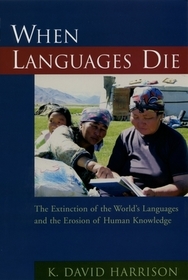
When Languages Die
The Extinction of the World's Languages and the Erosion of Human Knowledge
- Publisher's listprice GBP 24.49
-
11 057 Ft (10 530 Ft + 5% VAT)
The price is estimated because at the time of ordering we do not know what conversion rates will apply to HUF / product currency when the book arrives. In case HUF is weaker, the price increases slightly, in case HUF is stronger, the price goes lower slightly.
- Discount 10% (cc. 1 106 Ft off)
- Discounted price 9 951 Ft (9 477 Ft + 5% VAT)
Subcribe now and take benefit of a favourable price.
Subscribe
11 057 Ft

Availability
Only to order.
Why don't you give exact delivery time?
Delivery time is estimated on our previous experiences. We give estimations only, because we order from outside Hungary, and the delivery time mainly depends on how quickly the publisher supplies the book. Faster or slower deliveries both happen, but we do our best to supply as quickly as possible.
Product details:
- Publisher OUP USA
- Date of Publication 24 July 2008
- ISBN 9780195372069
- Binding Paperback
- No. of pages304 pages
- Size 233x167x17 mm
- Weight 426 g
- Language English
- Illustrations halftones, figures, tables 0
Categories
Long description:
It is commonly agreed by linguists and anthropologists that the majority of languages spoken now around the globe will likely disappear within our lifetime. The phenomenon known as language death has started to accelerate as the world has grown smaller.
This extinction of languages, and the knowledge therein, has no parallel in human history. K. David Harrison's book is the first to focus on the essential question, what is lost when a language dies? What forms of knowledge are embedded in a language's structure and vocabulary? And how harmful is it to humanity that such knowledge is lost forever?
Harrison spans the globe from Siberia, to North America, to the Himalayas and elsewhere, to look at the human knowledge that is slowly being lost as the languages that express it fade from sight. He uses fascinating anecdotes and portraits of some of these languages' last remaining speakers, in order to demonstrate that this knowledge about ourselves and the world is inherently precious and once gone, will be lost forever. This knowledge is not only our cultural heritage (oral histories, poetry, stories, etc.) but very useful knowledge about plants, animals, the seasons, and other aspects of the natural world--not to mention our understanding of the capacities of the human mind. Harrison's book is a testament not only to the pressing issue of language death, but to the remarkable span of human knowledge and ingenuity. It will fascinate linguists, anthropologists, and general readers.
In this scholarly yet very readable study, Harrison writes powerfully of the value and beauty of these vanishing knowledge systems.

