

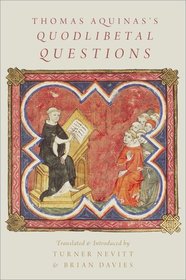
Thomas Aquinas's Quodlibetal Questions
- Publisher's listprice GBP 52.00
-
23 478 Ft (22 360 Ft + 5% VAT)
The price is estimated because at the time of ordering we do not know what conversion rates will apply to HUF / product currency when the book arrives. In case HUF is weaker, the price increases slightly, in case HUF is stronger, the price goes lower slightly.
- Discount 20% (cc. 4 696 Ft off)
- Discounted price 18 782 Ft (17 888 Ft + 5% VAT)
- Discount is valid until: 30 June 2026
Subcribe now and take benefit of a favourable price.
Subscribe
23 478 Ft

Availability
Estimated delivery time: In stock at the publisher, but not at Prospero's office. Delivery time approx. 3-5 weeks.
Not in stock at Prospero.
Why don't you give exact delivery time?
Delivery time is estimated on our previous experiences. We give estimations only, because we order from outside Hungary, and the delivery time mainly depends on how quickly the publisher supplies the book. Faster or slower deliveries both happen, but we do our best to supply as quickly as possible.
Product details:
- Publisher OUP USA
- Date of Publication 31 January 2020
- ISBN 9780190069537
- Binding Paperback
- No. of pages592 pages
- Size 155x234x40 mm
- Weight 816 g
- Language English 0
Categories
Short description:
Thomas Aquinas was one of the most significant Christian thinkers of the middle ages and ranks among the greatest philosophers and theologians of all time. The Quodlibetal Questions are his edited records of the public debates over which he presided at the University of Paris in the mid-thirteenth century. They contain Aquinas's treatment of hundreds of questions on a very wide range of philosophical and theological topics, all of which were chosen by his live audience. As such, Aquinas's Quodlibetal Questions provide a window onto the interests at the time, and contain some of Aquinas's fullest or only treatments of questions of interest both then and now.
MoreLong description:
Thomas Aquinas was one of the most significant Christian thinkers of the middle ages and ranks among the greatest philosophers and theologians of all time. In the mid-thirteenth century, as a teacher at the University of Paris, Aquinas presided over public university-wide debates on questions that could be put forward by anyone about anything. The Quodlibetal Questions are Aquinas's edited records of these debates. Unlike his other disputed questions, which are limited to a few specific topics such as evil or divine power, Aquinas's Quodlibetal Questions contain his treatment of hundreds of questions on a wide range of topics--from ethics, metaphysics, philosophy of mind, and philosophy of religion to dogmatic theology, sacramental theology, moral theology, eschatology, and much more. And, unlike his other disputed questions, none of the questions treated in his Quodlibetal Questions were of Aquinas's own choosing--they were all posed for him to answer by those who attended the public debates. As such, this volume provides a window onto the concerns of students, teachers, and other interested parties in and around the university at that time. For the same reason it contains some of Aquinas's fullest, and in certain cases his only, treatments of philosophical and theological questions that have maintained their interest throughout the centuries.
We should be very grateful to Nevitt and Davies that they have translated Thomas Aquinas's Quodlibetal Questions, enabling us to assess each quodlibet as an individual performance in an exacting genre, where truth is sought through combat.
Table of Contents:
Preface
Note on the Translation
Introduction
Quodlibet I
Question 1: God's Divine Nature
Question 2: God's Assumed Human Nature
Question 3: Angels
Question 4: Human Nature
Question 5: Contrition
Question 6: Confession
Question 7: Relating to Clerics
Question 8: Relating to Religious
Question 9: Sin
Question 10: Glory
Quodlibet II
Question 1: Christ
Question 2: The Composition of Angels
Question 3: The Time of the Movement of Angels
Question 4: Virtues Related to Divine Matters
Question 5: Virtues Related to Human Matters
Question 6: Sins
Question 7: Punishments for Sins
Question 8: Forgiveness of Sins
Quodlibet III
Question 1: God's Divine Nature
Question 2: God's Assumed Human Nature
Question 3: Angels
Question 4: Teachers of Sacred Scripture
Question 5: Becoming a Religious
Question 6: Being a Religious
Question 7: Relating to the Laity
Question 8: The Soul's Substance
Question 9: The Soul's Knowledge
Question 10: The Soul's Punishment
Question 11: The Body
Question 12: Conscience
Question 13: Penance
Question 14: Purely Bodily Creatures
Quodlibet VI
Question 1: God
Question 2: Angels
Question 3: The Sacrament of Baptism
Question 4: Faith
Question 5: Relating to Religion or Worship
Question 6: Obedience
Question 7: Alms Given by Clerics
Question 8: Alms Given on Behalf of the Dead
Question 9: Sins
Question 10: Bodily Things
Question 11: Purely Bodily Creatures
Quodlibet IV
Question 1: God's Knowledge
Question 2: God's Power
Question 3: The Extent of God's Power
Question 4: The Son's Divine Nature
Question 5: The Son's Assumed Nature
Question 6: Grace
Question 7: The Sacraments of Grace
Question 8: Human Acts Related to Superiors and Prelates
Question 9: Human Acts Related to the Intellect
Question 10: The Act of Martyrdom
Question 11: Evil Acts
Question 12: The Religious Life
Quodlibet V
Question 1: God's Knowledge
Question 2: God's Power
Question 3: God's Assumed Nature
Question 4: Angels
Question 5: Human Nature
Question 6: The Sacrament of the Eucharist
Question 7: The Sacrament of Penance
Question 8: The Sacrament of Marriage
Question 9: Relating to the Virtues
Question 10: Relating to the Commandments
Question 11: Relating to Prelates
Question 12: Relating to Teachers
Question 13: Relating to Religious
Question 14: Relating to Clerics
Quodlibet VII
Question 1: The Knowledge of Spiritual Substances
Question 2: The Enjoyment of Christ's Soul During the Passion
Question 3: The Plurality of Spiritual Substances
Question 4: The Sacrament of the Altar
Question 5: The Bodies of the Damned
Question 6: The Senses of Sacred Scripture
Question 7: Manual Labor
Quodlibet VIII
Question 1: The Divine Ideas
Question 2: The Human Soul
Question 3: The Human Body
Question 4: Matters of Grace Related to Prelates
Question 5: Matters of Grace Related to Everyone
Question 6: Sin
Question 7: The Spiritual Punishment of the Damned
Question 8: The Bodily Punishment of the Damned
Question 9: The Glory of the Blessed
Quodlibet IX
Question 1: Christ's Divine Nature
Question 2: The Union of Christ's Human and Divine Natures
Question 3: The Outward Appearances Containing Christ in the Sacrament of the Altar
Question 4: Angels
Question 5: Human Nature
Question 6: Grace
Question 7: Sin
Question 8: Glory
Quodlibet X
Question 1: God
Question 2: Angels
Question 3: The Soul's Substance
Question 4: The Soul's Activity
Question 5: Matters of Grace Related to Commandments and Counsels
Question 6: Sins Opposed to Right Action
Question 7: Sins Opposed to Right Faith
Question 8: Glory
Quodlibet XI
Question 1: God's Infinity
Question 2: God's Knowledge
Question 3: God's Predestination
Question 4: Angels
Question 5: The Human Soul
Question 6: The Human Body
Question 7: The Sacrament of Confirmation
Question 8: The Sacrament of the Eucharist
Question 9: The Sacrament of Marriage
Question 10: Fraternal Correction
Quodlibet XII
Question 1: God's Existence
Question 2: God's Power
Question 3: God's Predestination
Question 4: Angels
Question 5: The Heavens
Question 6: The Human Soul
Question 7: Human Knowledge
Question 8: Consequences of Human Knowledge
Question 9: The Sacrament of Baptism
Question 10: The Sacrament of Penance
Question 11: An Effect of the Sacraments
Question 12: The Identity of the Church
Question 13: The Intellectual Virtue of Truth
Question 14: The Moral Virtues
Question 15: Restitution
Question 16: The Office of Commentators on Sacred Scripture
Question 17: The Office of Preachers
Question 18: The Office of Confessors
Question 19: The Office of Vicars
Question 20: Original Sin
Question 21: Actual Sins of Thought
Question 22: Actual Sins of Action
Question 23: Punishments
Abbreviations
Parallel Passages
Glossary of Terms
Glossary of Authors and Works Cited
Notes
Index

