

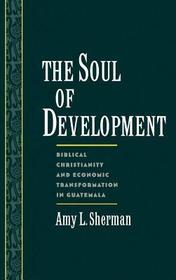
The Soul of Development
Biblical Christianity and Economic Transformation in Guatemala
Series: Religion in America;
- Publisher's listprice GBP 140.00
-
63 210 Ft (60 200 Ft + 5% VAT)
The price is estimated because at the time of ordering we do not know what conversion rates will apply to HUF / product currency when the book arrives. In case HUF is weaker, the price increases slightly, in case HUF is stronger, the price goes lower slightly.
- Discount 10% (cc. 6 321 Ft off)
- Discounted price 56 889 Ft (54 180 Ft + 5% VAT)
Subcribe now and take benefit of a favourable price.
Subscribe
63 210 Ft

Availability
printed on demand
Why don't you give exact delivery time?
Delivery time is estimated on our previous experiences. We give estimations only, because we order from outside Hungary, and the delivery time mainly depends on how quickly the publisher supplies the book. Faster or slower deliveries both happen, but we do our best to supply as quickly as possible.
Product details:
- Publisher OUP USA
- Date of Publication 26 June 1997
- ISBN 9780195106718
- Binding Hardback
- No. of pages232 pages
- Size 161x237x20 mm
- Weight 558 g
- Language English 0
Categories
Short description:
Sherman argues that Latin America's Protestant revival is likely to help the prospects for the region's economic growth and democratic development. Focusing on Guatemala's rural poor, she explains how conversion from animism to a Biblically orthodox world-view has improved the domestic welfare and economic status of many families.
MoreLong description:
Ever since Max Weber started an argument about the role of Protestantism in jump-starting northern Europe's economic development, scholars have clashed over the influence of religion and culture on a society's (or an individual's) economic prospects. Today, many wonder whether the "explosion" of Protestantism in Latin America will effect a similar wave of growth and democratization. In this book, Sherman compiles the results of her field study and national survey of 1000 rural Guatemalan households. She offers persuasive evidence that, in Guatemala and throughout the region, religious world-views significantly influence economic life. Sherman explains how the change in attitude and behaviour that accompanies conversion from animism to a Biblically orthodox world-view has improved the domestic welfare and economic status of many families. Further, she asserts that this new attitude, sympathetic to democratic-capitalism, has created a "moral cultural soil" in which freedom, personal empowerment, an enhanced status for women, and a desire to get ahead can be nurtured.
A very interesting and thought-provoking contribution to the discussion on religion and economic development

