

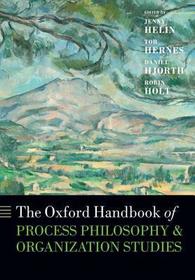
The Oxford Handbook of Process Philosophy and Organization Studies
Series: Oxford Handbooks;
- Publisher's listprice GBP 36.99
-
16 700 Ft (15 905 Ft + 5% VAT)
The price is estimated because at the time of ordering we do not know what conversion rates will apply to HUF / product currency when the book arrives. In case HUF is weaker, the price increases slightly, in case HUF is stronger, the price goes lower slightly.
- Discount 10% (cc. 1 670 Ft off)
- Discounted price 15 030 Ft (14 315 Ft + 5% VAT)
Subcribe now and take benefit of a favourable price.
Subscribe
16 700 Ft

Availability
printed on demand
Why don't you give exact delivery time?
Delivery time is estimated on our previous experiences. We give estimations only, because we order from outside Hungary, and the delivery time mainly depends on how quickly the publisher supplies the book. Faster or slower deliveries both happen, but we do our best to supply as quickly as possible.
Product details:
- Publisher OUP Oxford
- Date of Publication 29 October 2015
- ISBN 9780198746539
- Binding Paperback
- No. of pages650 pages
- Size 246x171 mm
- Weight 1120 g
- Language English 0
Categories
Short description:
This Handbook presents key ideas of philosophers and social theorists whose ideas inform process approaches to organization studies. Each chapter addresses the background and context of this thinker, their work (with a focus on the processual elements), and the potential contribution to organization and management research.
MoreLong description:
Process approaches to organization studies focus on flow, activities, and evolution, understanding organizations and organizing as processes in the making. They stand in contrast to positivist approaches that see organizations and phenomena as fixed, static, and measurable.
Process approaches draw on a range of ideas and philosophies. The Handbook examines 34 philosophers and social theorists, both those commonly linked to process thinking, such as Whitehead, Bergson and James, and those that are not as often addressed from a process perspective such as Dilthey and Tarde. Each chapter addresses the background and context of this thinker, their work (with a focus on the processual elements), and the potential contribution to organization and management research. For students and scholars in the field of Organization Studies this book is an entry point into the work of philosophical thinkers and social theorists for whom the world is far from being a solid place.
Table of Contents:
Process is how process does
Laozi's Daodejing (6th century BC)
Heraclitus (540-480 BC)
Confucius (551-479 BC)
Zhuang Zi
Baruch Spinoza (1632-1677)
Gottfried Leibniz (1646-1716)
Soren Kierkegaard (1813-1855)
Wilhelm Dilthey (1833-1911)
Charles Sanders Peirce (1839-1914)
William James (1842- 1910)
Gabriel Tarde (1843-1904)
Friedrich Nietzsche (1844-1900)
Henri Bergson (1859-1941)
John Dewey (1859-1952)
Alfred North Whitehead (1861-1947)
George Herbert Mead (1863-1931)
Nishida Kitaro (1870-1945)
Ludwig Wittgenstein (1889-1952)
Martin Heidegger (1889 - 1976)
Mikhail Bakhtin (1895-1975)
Jacques-Marie-?mile Lacan (1901-1981)
Gregory Bateson (1904-1980)
Hannah Arendt (1906-1975)
Simone de Beauvoir (1908-1986)
Maurice Merleau-Ponty (1908 - 1961)
Arne Naess (1912 2009)
Paul Ricoeur (1913-2005)
Harold Garfinkel (1917-2011)
George Spencer Brown (1923b)
Gilles Deleuze (1925-1995)
Michel Foucault (1926-1984)
Luce Irigaray (1930b)
Michel Serres (1930b)
Peter Sloterdijk (1947b)
Process and Reality

