

- Publisher's listprice GBP 222.50
-
100 458 Ft (95 675 Ft + 5% VAT)
The price is estimated because at the time of ordering we do not know what conversion rates will apply to HUF / product currency when the book arrives. In case HUF is weaker, the price increases slightly, in case HUF is stronger, the price goes lower slightly.
- Discount 10% (cc. 10 046 Ft off)
- Discounted price 90 413 Ft (86 108 Ft + 5% VAT)
Subcribe now and take benefit of a favourable price.
Subscribe
100 458 Ft

Availability
printed on demand
Why don't you give exact delivery time?
Delivery time is estimated on our previous experiences. We give estimations only, because we order from outside Hungary, and the delivery time mainly depends on how quickly the publisher supplies the book. Faster or slower deliveries both happen, but we do our best to supply as quickly as possible.
Product details:
- Publisher OUP Oxford
- Date of Publication 25 June 1998
- ISBN 9780198152453
- Binding Hardback
- No. of pages358 pages
- Size 224x145x25 mm
- Weight 593 g
- Language English 0
Categories
Short description:
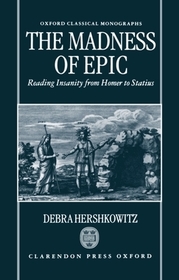
Madness features in many ancient epics: not only do characters go mad, but madness often plays an important thematic role. This book examines the representation and poetic function of madness in epic poetry (including the work of Homer, Virgil, and Ovid), addresses the difficulty of defining madness, and discusses how each epic explores the theme in a unique way.
MoreLong description:
Madness plays a vital role in many ancient epics: not only do characters go mad, but madness also often occupies a central thematic position in the texts. In this book, Debra Hershkowitz examines from a variety of theoretical angles the representation and poetic function of madness in Greek and Latin epic from Homer through the Flavians, including individual chapters devoted to the Iliad and Odyssey, Virgil's Aeneid, Ovid's Metamorphoses, Lucan's Bellum Civile, and Statius' Thebaid. The study also addresses the difficulty of defining madness, and discusses how each epic explores this problem in a different way, finding its own unique way of conceptualizing madness. Epic madness interacts with ancient models of madness, but also, even more importantly, with previous representations of madness in the literary tradition. Likewise, the reader's response to epic madness is influenced by both ancient and modern views of madness, as well as by an awareness of intertextuality.
Rich fare ... Hershkowitz has the original Greek and Latin texts at her intellectual fingertips.

