

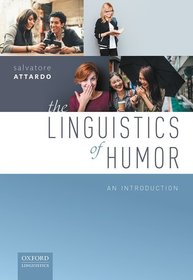
The Linguistics of Humor
An Introduction
- Publisher's listprice GBP 120.00
-
54 180 Ft (51 600 Ft + 5% VAT)
The price is estimated because at the time of ordering we do not know what conversion rates will apply to HUF / product currency when the book arrives. In case HUF is weaker, the price increases slightly, in case HUF is stronger, the price goes lower slightly.
- Discount 10% (cc. 5 418 Ft off)
- Discounted price 48 762 Ft (46 440 Ft + 5% VAT)
Subcribe now and take benefit of a favourable price.
Subscribe
54 180 Ft

Availability
printed on demand
Why don't you give exact delivery time?
Delivery time is estimated on our previous experiences. We give estimations only, because we order from outside Hungary, and the delivery time mainly depends on how quickly the publisher supplies the book. Faster or slower deliveries both happen, but we do our best to supply as quickly as possible.
Product details:
- Publisher OUP Oxford
- Date of Publication 25 June 2020
- ISBN 9780198791270
- Binding Hardback
- No. of pages488 pages
- Size 250x179x33 mm
- Weight 1040 g
- Language English 7
Categories
Short description:
This book is the first comprehensive and systematic introduction to the linguistics of humor, exploring not only theoretical linguistic analyses, but also topics from applied linguistics. It will be a valuable resource for students from advanced undergraduate level upwards, particularly those coming to linguistics from related disciplines.
MoreLong description:
This book is the first comprehensive and systematic introduction to the linguistics of humor. Salvatore Attardo takes a broad approach to the topic, exploring not only theoretical linguistic analyses, but also pragmatic and semantic aspects, conversation and discourse analysis, ethnomethodology, and interactionist and variationist sociolinguistics. The volume begins with chapters that introduce the terminology and conceptual and methodological apparatus, as well as outlining the major theories in the field and examining incongruity and resolution and the semiotics of humor. The second part of the book explores humor competence, with chapters that cover semantic and pragmatic topics, the General Theory of Verbal Humor, and puns and their interpretation. The third part provides an in-depth discussion of the applied linguistics of humor, and examines social context, discourse and conversation analysis, and sociolinguistic aspects. In the final part of the book, the discussion is extended beyond the central field of linguistics, with chapters discussing humor in literature, in translation, and in the classroom.
The volume brings together the multiple strands of current knowledge about humor and linguistics, both theoretical and applied; it assumes no prior background in humor studies, and will be a valuable resource for students from advanced undergraduate level upwards, particularly those coming to linguistics from related disciplines.
This elementary book is well structured and presented for readers without prior training in humor studies. Overall, it provides a clear foundation for understanding humor's embedding in linguistic practice, and its distinct (yet overlapping) cognitive, emotional, and physiological/embodied manifestations. As awkward as it can sometimes be to explain a joke, I enjoyed every aspect of this enlightening, eye-opening book.
Table of Contents:
Preface
List of figures and tables
Part I: Humor Studies
Humor studies: A few definitions
Methodological preliminaries
Theories of humor and their levels
Incongruity and resolution
Semiotics of humor
Part II: Humor Competence
The semantics of humor
The General Theory of Verbal Humor
Pragmatics of humor
Verbal humor
Part III: Humor Performance
The performance of humor
Conversation analysis: Humor in conversation I
Discourse analysis: Humor in conversation II
Sociolinguistics of humor
Part IV: Applications
Humor in literature
Humor and translation
Humor in the classroom
Conclusion
Glossary
References
Index

