

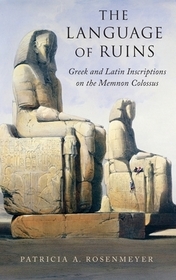
The Language of Ruins
Greek and Latin Inscriptions on the Memnon Colossus
- Publisher's listprice GBP 105.00
-
47 407 Ft (45 150 Ft + 5% VAT)
The price is estimated because at the time of ordering we do not know what conversion rates will apply to HUF / product currency when the book arrives. In case HUF is weaker, the price increases slightly, in case HUF is stronger, the price goes lower slightly.
- Discount 10% (cc. 4 740 Ft off)
- Discounted price 42 667 Ft (40 635 Ft + 5% VAT)
Subcribe now and take benefit of a favourable price.
Subscribe
47 407 Ft

Availability
printed on demand
Why don't you give exact delivery time?
Delivery time is estimated on our previous experiences. We give estimations only, because we order from outside Hungary, and the delivery time mainly depends on how quickly the publisher supplies the book. Faster or slower deliveries both happen, but we do our best to supply as quickly as possible.
Product details:
- Publisher OUP USA
- Date of Publication 10 May 2018
- ISBN 9780190626310
- Binding Hardback
- No. of pages296 pages
- Size 236x155x25 mm
- Weight 748 g
- Language English
- Illustrations 12 illustrations 0
Categories
Short description:
The first critical assessment of all the inscriptions discovered at the Memnon colossus considered in their social, cultural, and historical context.
MoreLong description:
A colossal statue, originally built to honor an ancient pharaoh, still stands today in Egyptian Thebes, with more than a hundred Greek and Latin inscriptions covering its lower surfaces. Partially damaged by an earthquake, and later re-identified as the Homeric hero Memnon, it was believed to "speak" regularly at daybreak. By the middle of the first century CE, tourists flocked to the colossus of Memnon to hear the miraculous sound, and left behind their marks of devotion (proskynemata): brief acknowledgments of having heard Memnon's cry; longer lists by Roman administrators; and more elaborate elegiac verses by both amateur and professional poets. The inscribed names left behind reveal the presence of emperors and soldiers, provincial governors and businessmen, elite women and military wives, and families with children.
While recent studies of imperial literature acknowledge the colossus, few address the inscriptions themselves. This book is the first critical assessment of all the inscriptions considered in their social, cultural, and historical context. The Memnon colossus functioned as a powerful site of engagement with the Greek past, and appealed to a broad segment of society. The inscriptions shed light on contemporary attitudes toward sacred tourism, the role of Egypt in the Greco-Roman imagination, and the cultural legacy of Homeric epic. Memnon is a ghost from the Homeric past anchored in the Egyptian present, and visitors yearned for a "close encounter" that would connect them with that distant past. The inscriptions thus idealize Greece by echoing archaic literature in their verses at the same time as they reflect their own historical horizon. These and other subjects are expertly explored in the book, including a fascinating chapter on the colossus's post-classical life when the statue finds new worshippers among Romantic artists and poets in nineteenth-century Europe.
The Language of Ruins' will, I suspect, be the definitive account of the Memnon inscriptions for many years to come.
Table of Contents:
List of Illustrations and Tables
Acknowledgments
Preface
1. Reading the Colossus: The Memnon Inscriptions
2. Worshipping the Colossus: Sacred Tourism at Thebes
3. Talking with the Colossus: The Rhetoric of Address
4. Homeric Memnon
5. Sapphic Memnon
6. Modern Memnon
Appendices
Bibliography
Indexes

