

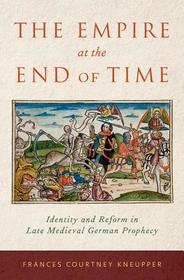
The Empire at the End of Time
Identity and Reform in Late Medieval German Prophecy
- Publisher's listprice GBP 93.00
-
41 989 Ft (39 990 Ft + 5% VAT)
The price is estimated because at the time of ordering we do not know what conversion rates will apply to HUF / product currency when the book arrives. In case HUF is weaker, the price increases slightly, in case HUF is stronger, the price goes lower slightly.
- Discount 10% (cc. 4 199 Ft off)
- Discounted price 37 791 Ft (35 991 Ft + 5% VAT)
Subcribe now and take benefit of a favourable price.
Subscribe
41 989 Ft

Availability
printed on demand
Why don't you give exact delivery time?
Delivery time is estimated on our previous experiences. We give estimations only, because we order from outside Hungary, and the delivery time mainly depends on how quickly the publisher supplies the book. Faster or slower deliveries both happen, but we do our best to supply as quickly as possible.
Product details:
- Publisher OUP USA
- Date of Publication 21 April 2016
- ISBN 9780190279363
- Binding Hardback
- No. of pages280 pages
- Size 239x157x25 mm
- Weight 544 g
- Language English
- Illustrations 1 0
Categories
Short description:
In The Empire at the End of Time, Frances Courtney Kneupper introduces popular eschatological prophecies of the late medieval Empire.
MoreLong description:
In this book, Frances Courtney Kneupper examines the apocalyptic prophecies of the late medieval Empire, which even within the sensational genre of eschatological prophecy stand out for their bitter and violent nature. In addition to depicting the savage chastisement of the clergy and the forcible restructuring of the Church, these prophecies also infuse the apocalyptic narrative with explicitly German elements-in fact, German speakers are frequently cast as the agents of these stirring events in which the clergy suffer tribulations and the Church hierarchy is torn down.
These prophecies were widely circulated throughout late medieval German-speaking Europe. Kneupper explores their significance for members of the Empire from 1380 to 1480, arguing that increased literacy, the development of strong urban centers, the drive for reform, and a connection to the imperial crown were behind their popularity. Offering detailed accounts of the most significant prophecies, Kneupper shows how they fit into currents of thought and sentiment in the late medieval Empire. In particular, she considers the relationships of German prophecy to contemporary discourses on Church reform and political identity. She finds that eschatological thought was considered neither marginal nor heretical, but was embraced by a significant, orthodox population of German laypeople and clerics, demonstrating the importance of popular eschatological thought to the development of a self-conscious, reform-minded, German-identified Empire on the Eve of the Reformation.
Kneupper's book is a brilliant, engaging and most-needed analysis of a relatively reduced but influential corpus of late medieval literature that contributes to the understanding of the religious and political genesis of the Protestant Reform.
Table of Contents:
Map
Acknowledgments
Preface
Introduction
SECTION ONE: CONTEXT
1 Audience and Reception
SECTION TWO: INDIVIDUAL PROPHECIES OF LATE MEDIEVAL GERMAN-SPEAKING EUROPE
2 The Gamaleon Prophecy
3 The Letter of Brother Sigwalt
4 The Auffahrt Abend Prophecy
5 The Wirsberger Letters
SECTION THREE: THEMES IN LATE MEDIEVAL GERMAN PROPHECY
6 The Church and Clergy in Prophetic Thought
7 German Identity in Prophetic Thought
CONCLUSION
Appendix A
Appendix B
Appendix C
Notes
Bibliography
Index

