

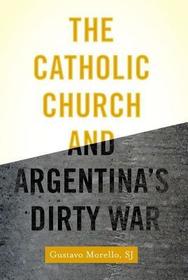
The Catholic Church and Argentina's Dirty War
- Publisher's listprice GBP 32.49
-
14 669 Ft (13 970 Ft + 5% VAT)
The price is estimated because at the time of ordering we do not know what conversion rates will apply to HUF / product currency when the book arrives. In case HUF is weaker, the price increases slightly, in case HUF is stronger, the price goes lower slightly.
- Discount 10% (cc. 1 467 Ft off)
- Discounted price 13 202 Ft (12 573 Ft + 5% VAT)
Subcribe now and take benefit of a favourable price.
Subscribe
14 669 Ft

Availability
printed on demand
Why don't you give exact delivery time?
Delivery time is estimated on our previous experiences. We give estimations only, because we order from outside Hungary, and the delivery time mainly depends on how quickly the publisher supplies the book. Faster or slower deliveries both happen, but we do our best to supply as quickly as possible.
Product details:
- Publisher OUP USA
- Date of Publication 30 May 2019
- ISBN 9780190947446
- Binding Paperback
- No. of pages242 pages
- Size 236x160x17 mm
- Weight 454 g
- Language English 0
Categories
Short description:
Drawing on interviews with victims of forced disappearance, documents from the state and the Church, as well as field work and participant observation, The Catholic Church and Argentina's Dirty War explores how the Argentine government deployed the legitimating discourse of Catholicism to justify terrorism in the case of La Salette missionaries. It examines how the official Catholic hierarchy rationalized their silence, and how the victims understood their Catholic faith in such a context.
MoreLong description:
On August 3rd, 1976, in Córdoba, Argentina's second largest city, Fr. James Week and five seminarians from the Missionaries of La Salette were kidnapped. A mob burst into the house they shared, claiming to be police looking for "subversive fighters." The seminarians were jailed and tortured for two months before eventually being exiled to the United States.
The perpetrators were part of the Argentine military government that took power under President General Jorge Videla in 1976, ostensibly to fight Communism in the name of Christian Civilization. Videla claimed to lead a Catholic government, yet the government killed and persecuted many Catholics as part of Argentina's infamous Dirty War. Critics claim that the Church did nothing to alleviate the situation, even serving as an accomplice to the dictators. Leaders of the Church have claimed they did not fully know what was going on, and that they tried to help when they could. Gustavo Morello draws on interviews with victims of forced disappearance, documents from the state and the Church, field observation, and participant observation in order to provide a deeper view of the relationship between Catholicism and state terrorism during Argentina's Dirty War.
Morello uses the case of the seminarians to explore the complex relationship between Catholic faith and political violence during the Dirty War-a relationship that has received renewed attention since Argentina's own Jorge Mario Bergoglio became Pope Francis. Unlike in countries such as Chile and Brazil, Argentina's political violence was seen as an acceptable tool in propagating political involvement; both the guerrillas and the military government were able to gain popular support. Morello examines how the Argentine government deployed a discourse of Catholicism to justify the violence that it imposed on Catholics and how the official Catholic hierarchy in Argentina rationalized their silence in the face of this violence. Most interestingly, Morello investigates how Catholic victims of state violence and their supporters understood their own faith in this complicated context: what it meant to be Catholic under Argentina's dictatorship.
The Catholic Church and Argentina's Dirty War by Gustavo Morello, SJ, makes an important contribution to the literature that has been trying to understand the behavior of religious actors and institutions during times of state violence.
Table of Contents:
Acknowledgments
Preface
Abbreviations
Chapter 1: Introduction
Chapter 2: "We are here to serve!"
Chapter 3: Who the La Salettes were
Chapter 4: Committed Catholics and the machinery of terror
Chapter 5: The long night
Chapter 6: "I was in Hell"
Chapter 7: A race against time
Chapter 8: "Aren't we true Catholics?"
Chapter 9: Varieties of Catholicism
References

