

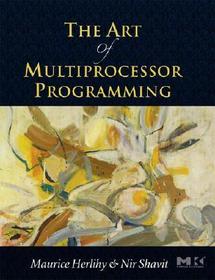
The Art of Multiprocessor Programming
Design for Testability
- Publisher's listprice EUR 56.95
-
22 244 Ft (21 185 Ft + 5% VAT)
The price is estimated because at the time of ordering we do not know what conversion rates will apply to HUF / product currency when the book arrives. In case HUF is weaker, the price increases slightly, in case HUF is stronger, the price goes lower slightly.
- Discount 10% (cc. 2 224 Ft off)
- Discounted price 20 020 Ft (19 067 Ft + 5% VAT)
Subcribe now and take benefit of a favourable price.
Subscribe
22 244 Ft

Availability
Out of print
Why don't you give exact delivery time?
Delivery time is estimated on our previous experiences. We give estimations only, because we order from outside Hungary, and the delivery time mainly depends on how quickly the publisher supplies the book. Faster or slower deliveries both happen, but we do our best to supply as quickly as possible.
Product details:
- Publisher Elsevier Science
- Date of Publication 29 April 2008
- ISBN 9780123705914
- Binding Paperback
- No. of pages528 pages
- Size 234x190 mm
- Weight 890 g
- Language English 0
Categories
Long description:
The Art of Multiprocessor Programming promises to be the first comprehensive presentation of the principles and tools available for programming multiprocessor machines.
As the computer industry changes from single-processor to multiprocessor architectures, this revolution requires a fundamental change in how programs are written. To leverage the performance and power of multiprocessor programming, also known as multicore programming, programmers need to learn the new principles, algorithms, and tools.
The book will be of immediate use to programmers working with the new architectures. For example, the next generation of computer game consoles will all be multiprocessor-based, and the game industry is currently struggling to understand how to address the programming challenges presented by these machines. This change in the industry is so fundamental that it is certain to require a significant response by universities, and courses on multicore programming will become a staple of computer science curriculums.
This book includes fully-developed Java examples detailing data structures, synchronization techniques, transactional memory, and more.
Students in multiprocessor and multicore programming courses and engineers working with multiprocessor and multicore systems will find this book quite useful.
MoreTable of Contents:
1 Introduction; 2 Mutual Exclusion; 3 Concurrent Objects and Linearization; 4 Foundations of Shared Memory; 5 The Relative Power of Synchronization Methods; 6 The Universality of Consensus; 7 Spin Locks and Contention; 8 Monitors and Blocking Sychronization; 9 Linked Lists: the Role of Locking; 10 Concurrent Queues and the ABA Problem; 11 Concurrent Stakcs and Elimination; 12 Counting, Sorting and Distributed Coordinatino; 13 Concurrent Hashing and Natural Parallelism; 14 Skiplists and Balanced Search; 15 Priority Queues; 16 Futures, Scheduling and Work Distribution; 17 Barriers; 18 Transactional Memory; Appendices
More
