

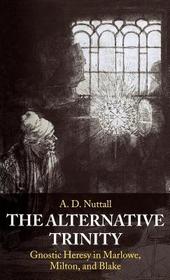
The Alternative Trinity
Gnostic Heresy in Marlowe, Milton, and Blake
- Publisher's listprice GBP 210.00
-
94 815 Ft (90 300 Ft + 5% VAT)
The price is estimated because at the time of ordering we do not know what conversion rates will apply to HUF / product currency when the book arrives. In case HUF is weaker, the price increases slightly, in case HUF is stronger, the price goes lower slightly.
- Discount 10% (cc. 9 482 Ft off)
- Discounted price 85 334 Ft (81 270 Ft + 5% VAT)
Subcribe now and take benefit of a favourable price.
Subscribe
94 815 Ft

Availability
printed on demand
Why don't you give exact delivery time?
Delivery time is estimated on our previous experiences. We give estimations only, because we order from outside Hungary, and the delivery time mainly depends on how quickly the publisher supplies the book. Faster or slower deliveries both happen, but we do our best to supply as quickly as possible.
Product details:
- Publisher Clarendon Press
- Date of Publication 30 July 1998
- ISBN 9780198184621
- Binding Hardback
- No. of pages296 pages
- Size 224x144x23 mm
- Weight 518 g
- Language English
- Illustrations 4 pp black and white plates 0
Categories
Short description:
What if the creator of the world were evil? What if Christ, the Son, were the antagonist not the ally of the Father? Nuttall tracks this subversive theology from the Gnostics of the second century, through its flickering reappearance in Marlowe and Milton, to its full development in Blake.
MoreLong description:
The Trinity of orthodox Christianity is harmonious. The Trinity for Blake is, conspicuously, not a happy family: the Father and the Son do not get on. It might be thought that so cumbersome a notion is inconceivable before the rise of Romanticism but the Ophite Gnostics of the second century AD appear to have thought that God the Father was a jealous tyrant because he forbade Adam and Eve to eat from the Tree of Knowledge and that the serpent, who led the way to the Tree of Knowledge, was really Christ. This book explores the possibility of an underground `perennial heresy', linking the Ophites to Blake. The `alternative Trinity' is intermittently visible in Marlowe's Doctor Faustus and even in Milton's Paradise Lost. Blake's notorious detection of a pro-Satan anti-poem, latent in this `theologically patriarchal' epic is less capricious, better grounded historically and philosophically, than is commonly realised.
Nuttall's book is a lively and learned study ... impressive mastery of theology combined with much sensitivity to textual and literary details.
Table of Contents:
Introduction
Part I. Blake: The Son Versus the Father
Part II. Raising the Devil: Marlowe's Doctor Faustus
Calvinists and Hermeticists
Flying Men and Gnostics
Part III. Milton
Satan's Shield
Milton's Theodicy: The Argument from Freedom
The Garden as Maze
The Fortunate Fall
Arianism, Monism, Materialism
The Invisible Christ
The Language of Trees: Unstable Mythologies
Part IV. Blake
Godly Nudists
The Matrix of Blake's Thought
Blake and Milton
Antinomian Blake
Contraries

